The SEVEN Sleeve Types...
(just about narrowed down!)

Ann Fanshaw's dress. 1751-52. Museum of London. Cuff Detail
The following Conclusion is based on my research so far (just to let you know) and this research is a mixture of paintings from the period, images of actual dresses from the period and a few research sessions at the Bath Fashion Museum. I'll try and put in the images I'm using or quoting so that you don't have to take my word for it.
And some quick N.B's before we get started:
- Obviously I am discussing here a general shift in the move of style from this period and also picking up when certain styles first seem to appear. I am not saying that this was what people wore all the time. One cannot control grannies.
Remember also that this is still before fashion plates and the understanding of what was in style came from what you saw those above you wear and the cartoons from newspapers mocking them. Fashion took it's time to filter through the ranks. (see Laver: 18th Century Costume)
- Secondly a lot of these sleeves types can merge into each other but I think, a bit like a rainbow, when red definitely becomes orange is when I've started a new category.
- Also, so far one of my general discoveries from this period is that the sleeves start looser and begin to become more shaped. This is a GENERAL rule of thumb and doesn't always apply, especially in the middle of the century when everything seemed to go hand in hand with everything else.
- And lastly, while writing this I've come to the conclusion that it might be easier to do this as a deeper study on an actual page. So this post is just going to be the outlines and then I can got into more research, images and pattern possibilities on the page designated for it.
- And lastly, while writing this I've come to the conclusion that it might be easier to do this as a deeper study on an actual page. So this post is just going to be the outlines and then I can got into more research, images and pattern possibilities on the page designated for it.
So, I think the 7 Sleeves are as follows...
- The Loose Sleeve (with a plain hem).
- The Loose Sleeve with folded Cuff - grown-on.
- The Separate Cuff.
- The Pagoda Sleeve or Ruffled Sleeve.
- The Plain Ended Fitted Sleeve.
- The Curved Sleeve.
- The Fully Frilled Sleeve.
- The Loose Sleeve (with a plain hem).
- The Loose Sleeve with folded Cuff - grown-on.
- The Separate Cuff.
- The Pagoda Sleeve or Ruffled Sleeve.
- The Plain Ended Fitted Sleeve.
- The Curved Sleeve.
- The Fully Frilled Sleeve.
THE LOOSE SLEEVE (with plain hem)

Pesne - 1716 - Crown Prince Ludwig and wife.
This tends, as far as I can tell, to be mainly at the beginning of the century, starting life off as 'very baggy' and then becoming less so. I think it also has a few sub-categories as it developed and can include being worn with lace, or without, with ruffles directly from the shift, or even with a pinch detail (as shown above).

 Hogarth's 'Mary Edwards' is sporting a pair in her portrait (see above) and that's right into the 1740's. She wears hers with what I think are lace ruffles.
The 'Loose Sleeve' could blend into the 'Loose sleeve with folded cuff - grown-on' section that is next in line on this post but I've decided to keep them separate as one clearly has a cuff and the other clearly doesn't. The plain sleeve here with the pinch detail (just to confuse things) is, to me, the beginning of this 'Loose Sleeve with folded cuff -grown-on' but rather than the shape of the sleeve being completely altered and maybe even the pattern cutting being different, I think this is just literally pinching a few pleats into the fullness of the sleeve. Like I say there is a very fine line between some of these Sleeves and it's hard to tell when one becomes the other. Many of my images I have had to leave out as it's unclear as to which category they belong in.
LOOSE SLEEVE WITH FOLDED CUFF DETAIL (GROWN-ON):

George Whitefield by John Wollaston. 1742. National Portrait Gallery.
You can see relatively clearly in this painting that there's a pronounced cuff detail that's pinched into pleats at the front and sits at it's fullest at the back of the sleeve. You can see this if you concentrate on the silhouette of the lady's arm; it doesn't just become the sleeve again.
I'd like to have a play with this type of sleeve and see if I can't figure out how it was cut. There could be various ways. One possible way would be to create a bell bottom shape to the main sleeve body and once the pleats have been put in you could catch and pull the sleeve part just behind where the cuff would sit so that it tucks behind it a little. A shortened lining could do the same if it was lined and would be similar to the technique used in a modern day puff-ball skirt. The reason I have called this sleeve a 'grown-on' cuff is that I see no benefit to it being addied as a separate part and surely would make more work for the dressmaker. The sleeve doesn't seem to sit as if they were two distinct pieces. rather it appears to be happy in it's fullness. ...I might feel differently however when I have my play at pattern cutting.
 |
| Hayman - Mrs Mary Chauncey - 1748 |
Separate Cuff Detail:

('Mrs Hugh Bonfoy' by Reynolds, 1754)
 To grow this kind of cuff on, I think, would be over the top and kind of impossible. It'd be far easier to manage if it was treated as a separate piece. The main difference between this Sleeve Type and the previous is simply the size and pattern techniques. And note here, that the top of the sleeve is much more slimmer than previous sleeves and here we are only in the mid-century . The cuff here (above) is incredibly full and voluptuous and I don't think I've seen a version of it outside of a painting. This may well be because the cuff is of a more 'romantic' nature with it's sweeping folds of fabric. Antiquity and Pastoral themes were popular in paintings, the lady being styled as a 'heroine' or 'milkmaid' for example. (see the Duchess of Queensbury's painting on the 1720's Images page). This portrait has this kind of feel to it, a slightly dramatic atmosphere. But I think it unfair to suggests that because of this, these sleeves were NEVER part of a fashion trend that was actually worn.
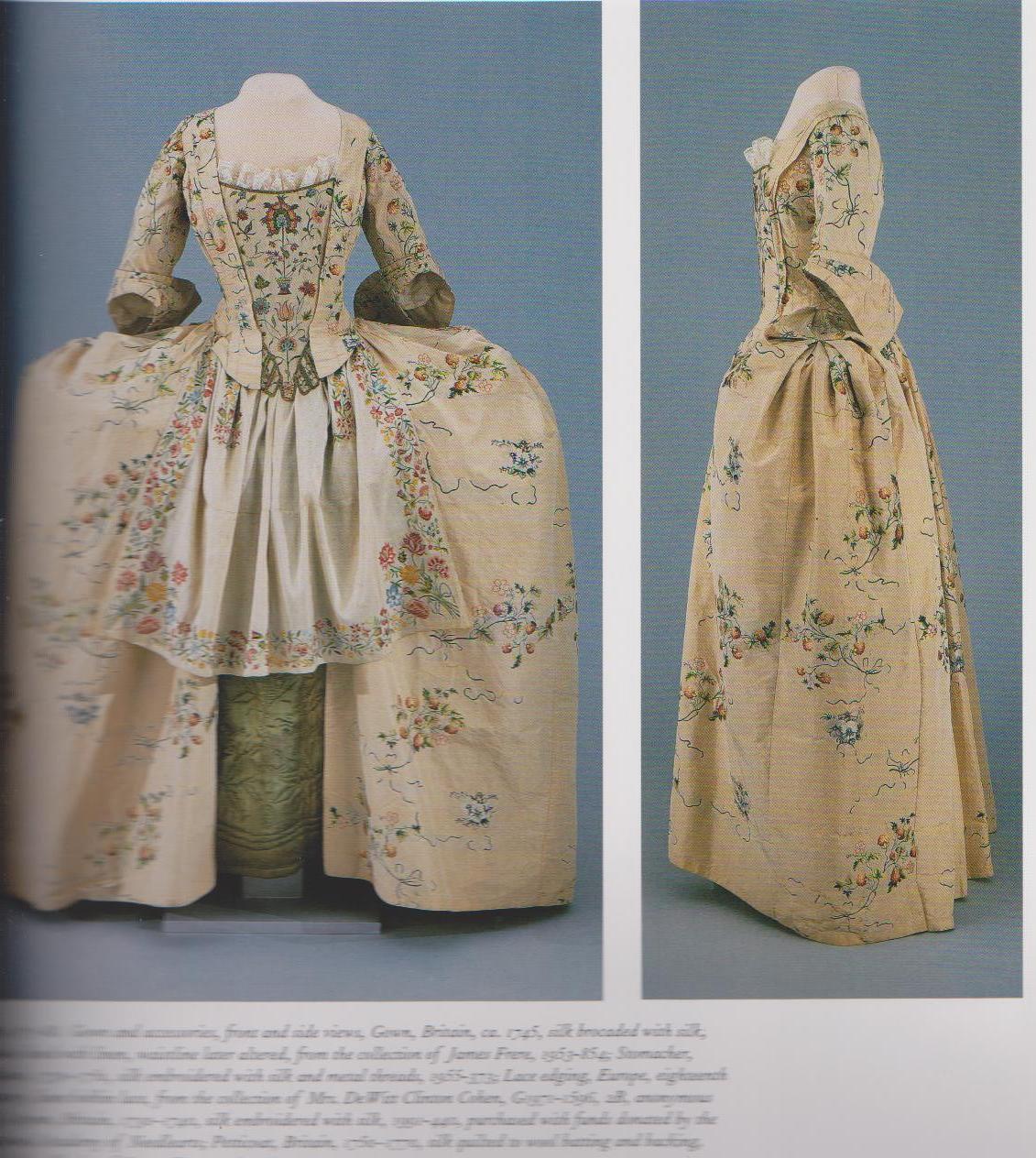
 The other, more seen version of this sleeve is where the cuff is much more pronounce and shaped. It harkens more to the military style and is seen both in portrait and actual dress. The image opposite here: Gainsborough's 'Mr and Mrs Carter', is painted in 1747-48 and shows the cuff clearly.
This is definitely a seperate cuff and would most likely have been made up first and then joined to the sleeve after the sleeve had been made up.
There's another image of this cuff on an actual dress from 1745. (See opposite)
Need I say more really...
Interestingly enough, there is actually a view up the sleeve from the front position and just shows a linen lining coming down and being sewn down onto the inside of the cuff.
This Separate Cuff detail can also be seen as a smaller version, less winged and more like the men's cuffs as they progressed into the century.
And just quickly, while we're on the subject; the sleeves on the 'Queensbury' portrait could be either grown-on or separate - it's another image that's not clear....See what you think.
I have just found an interesting quote by Iris Brooke in her book 'Dress and Undress'. She states that 'Earlier than 1750 the normal finish to a sleeve was the cuff, but later than 1750 the accent was on the frilling and the ruffles that showed beneath."
This applies then, both to the Cuff Finished Sleeve and to the Ruffled Sleeve and to the new imaginary line that the date 1750 now draws across the century.
The Pagoda Sleeve:
(or also 'Ruffled Sleeve')
 The Kyoto Institute calls this sleeve type a pagoda sleeve and so does John Peacock in his book 'The Chronicle of Western Costume' (see Bibliography page). His quote is: "Pagoda Sleeve: 18th Century. A woman's sleeve fitted on the upper arm above the elbow. Frill from elbow to mid-arm at the front and to the wrist or lower at the back."
He has a drawing accompanying it (see opposite).
However, Cunnington and Beard in 'A Dictionary of English Costume 900-1900' do not use the term 'pagoda' to describe this type of sleeve. Under the title 'Pagoda Sleeve' they write: '1849-1860's. (F) A sleeve with one seam on the inner side and cut so as to expand widely at the elbow..." they also write further on that this name was replaced by 'Funnel Sleeve by 1859.I looked up the term 'Ruffles' and although they use this term for eighteenth century sleeve wear it is only as the lace or shift ruffles worn under. I quote: 'C.1690 to the end of 18th c.(F.) Deep flounces of lace or cambric, worn with elbow-length sleeves. Often multiple and scalloped.'
However, Cunnington and Beard in 'A Dictionary of English Costume 900-1900' do not use the term 'pagoda' to describe this type of sleeve. Under the title 'Pagoda Sleeve' they write: '1849-1860's. (F) A sleeve with one seam on the inner side and cut so as to expand widely at the elbow..." they also write further on that this name was replaced by 'Funnel Sleeve by 1859.I looked up the term 'Ruffles' and although they use this term for eighteenth century sleeve wear it is only as the lace or shift ruffles worn under. I quote: 'C.1690 to the end of 18th c.(F.) Deep flounces of lace or cambric, worn with elbow-length sleeves. Often multiple and scalloped.'

Quilted Robe a la Francais - 1750.
At First, when I started researching this sleeve, there didn't seem to be much that needed saying: it was such classical and expected look to the Georgian period and seemed pretty stagnant in it's effect.
However it has more depth to it than at first appearance...
So here we go:
- It can come with one ruffle, or two, or three. (I have not yet seen four) and these ruffles (which I use to mean the self-fabric of the dress gathered up into the flounce) can be added to with great folds of lace or with frills that come from the shift (shift frills are mainly seen early to mid century - please see the Yearly Pages for examples of this.)
- The Ruffles can be incredibly full or quite meagre, sometimes more appearing like a trim than an actual ruffle.
It could be argued that a smaller ruffle is down to a tighter pocket and this is always an individual possiblity but I think if you look at the trends of the century as a whole you can see a spectrum of 'Loose becoming more fitted' and 'Large becoming more restrained'.
- Sometimes these ruffles are sewn on top of the sleeve and other times sewn into the end of sleeve.
- This sleeve, as far as I can tell at the moment, mainly appears on Sack-back gowns or 'Robe a la Francias' and Court Mantua's and especially gowns worn as 'evening wear' or 'Dress wear'. Mary Edward's Portrait stands as an exception to this rule and there are probably many others but I think on the whole they're mainly found on Sack-backs. If you go back up to Mary Edward's portrait in the 'loose sleeve' section you can see that she is wearing a Sack-back gown but her sleeves are a loose plain cuff.
 |
| Reynolds 'Mrs Molesworth' 1755. two ruffles and lace. I'd say that these Ruffles were of the 'quite full' variety and she appears to have a ribbon round the top of them as a detail. |
 |
| Perronneau's 'Madam de Sorquainville' 1749 With bow details on the top of the Ruffle. |
 |
| An example of a 3 layered Ruffle with Medium fullness. |
 |
| Cuff Detail of Ann Fanshaw's Dress 1751-52. An example of 'Quite full' Ruffles. |
- This sleeve type can also come with bows at the top of the ruffle (see Madam de Sorquainville 1749), ribbons, a gathered trim of self fabric, braiding or metallic lace. And the gathered trim of the self-same fabric could be quite large, or just a smaller detail.
 The bows: again, could be larger or smaller.
You can see on Ann Fanshaw's dress a metallic lace inserted both at the join of the ruffles and at their ends.
- They can have flowers sewn on, or be pinked and stamped (see yellow sleeve opposite), and the first image (the Quilted Robe a la Francais -1750 at the top) just shouts at how it has been made, the ruffle detail made as a separate piece and just simple sewn on top. And check out the beautiful sleeve beneath with it's striped silk and sewn on flowers. It also has a bow and embroidered flower detail that you can get a glimpse of if you look at the back of the Ruffle. The image of the red dress also below has this gathered self-fabric trim as quite a deep and full detail.
- There are so many options with this sleeve type and it'd be interesting to keep researching and see if these decorations keep to a pattern which we could be able to date.
 |
| V&A Sleeve Detail - 1770's. |
 |
| V&A 1760-69 |

This sleeve above is a wonderful example of the fine detail spent on Ruffles and how they could actually be quite small. This one also has a Cuff kind of trim above it as a separate detail and the main ruffle has been box pleated and not gathered. The only information for this sleeve is that it is mid 1700's which doesn't help us much in trying to date some of these fashions.

A German Robe a La Francais 1760-65. Again a smaller ruffle, this one is almost like a trim.
The Curved Sleeve:


When I've studied historical dresses up at the Bath Fashion Museum, this 'Curved Sleeve' detail has been a really interesting find for me. It is a very effective little sleeve. Most of the sleeves from this period are elbow length or 'three-quarter length' and having a shaped cuff is a very sweet way for it to sit round the elbow.
As with the other sleeves, this sleeve could come in a range of designs and to be honest, I'm not dead certain ALL of them count as 'Curved Sleeves' as they could be just a straight sleeve with a detail sewn on. It's hard to tell from just an image, but the reason why I am guessing and counting them as a 'Curved Sleeve' is that this 'vogue' mainly seems to come in mid century onward and about the same time as each other. Suddenly, it seems, you begin to see quite a few Ruffle-less, cuff-less sleeves with just a rouched detail, for example.
And I'm also not sure if some of the'Ruffled Sleeves' aren't infact 'Curved Sleeves' with a ruffle sewn on. It's hard to tell when you can't lay the garment out on the table and pick it over. Some of the Ruffled Sleeves are obviously not Curved Sleeves by the way they hang, but it's not an impossibilty that it did happen as this sleeve came in. There is one example of a kind of curved sleeve with ruffle detail, but it's so individual I'm not sure I really want to use it as an example. I won't put it here as it might cause confusion but check out the 1760 Images page and it's the green military costume of Catherine the Great.
Here below are some of the examples of Cuff details, that I believe are sewn onto a 'Curved Sleeve', they can come in many variations and often echoe the trimming on the dress itslef:
 |
| The Marlborough Family by Reynolds 1778. See the eldest Girl, far right, with her arm over the little girl with blue sash infront of her? Her sleeve is a curved sleeve. That was worth all the effort now wasn't it. |
 |
| Robe a la Francais - 1770-90. There are numerous examples of this kind of detail, a rouched ending, I think the cream and green and blue sleeves at the beginning of this section are all variations of this kind of trim. |
 |
| The Music Party by Trinquesse 1774. A pleated? cuff-size detail that matches her skirt trim. |
 |
| Gown 1770's. Three gathered bands, matching the trim. |
The Plain Ended, Fitted Sleeve:
This Sleeve type can come in 3 lengths: Short, Mid-length or long. If we're going to pinnickity we could complain that isn't the mid-length the same as the Loose Plain? Yes, but check out the titles. The 'Plain Ended Fitted Sleeve' isn't a 'Loose Plain Ended Sleeve'. Probably the only difference is time BUT knowing the distinction helps with dating garments and replicating them. If I went and put a nice neat, fitted sleeve on a 1720's garment just because I preferred it I wouldn't be doing a true replica.
Now, there really isn't much to say about this sleeve. It's plain ended. But I'll put a load of photo's up for the examples and so that you can see the differences.
Short Versions:
 |
| Pink Silk Dress and Petticoat c.1770's. |
 |
| Wedding Dress of Edwige Elisabeth De Holstein c.1774
Mid Length Versions;

Robe a la Anglais, C.1776

C.1760-70

Robe a la Polonaise c.1776-87
|
Long Length Versions:

Robe a la Polonaise c.1775-80

Elisabeth Ingram by Reynolds 1757

A Girl Reading by Fragonard 1776
Tight and well fitting, these sleeves accentuate maybe more of an air of smart casual, to coin a common phrase, than anything else and dresses with these types of sleeves always seem to come across like that to me. I think, if I'm honest, that I almost prefer this type of simple sleeve. There's no hiding any bad cutting skills behind a load of frills. These Sleeves are honest and just look so beautifully made.
The Fully Frilled Sleeve:
Isn't it amazing what you discover when you really get into research. I've always associated this type of sleeve with Victorian times, and although there is not an abundance of images wearing this type of sleeve, the ones that I have found are on some very important dresses.
Maybe as I get more research and images done I'll be able to add to this section but at the moment all I've found is what's below:
A mid-length sleeve with rows of gathered lace.

c.1751 (sorry it's such a small image)

1775.

Catherine The Great's Coronation Gown.12-09-1762

Rebecca Watson - Reynolds - 1758.
And that's me done, so far anyway.
The only other addition I'd like to show is an image of some lace finished sleeves which I'd like to research more, but it's worth putting it in now.
I'd imagine these lace cuffs could be worn with the Plain Ended Fitted Sleeve.

Bowes Museum c 1770's