Wednesday, 4 June 2014

Edinburgh National Portrait Gallery

National Portrait Gallery:

Edinburgh

We had a Study Session booked at the National Collection Centre in Edinburgh last week. So off we set, across the country to have a look at some Eighteenth Century Stays, Shifts and Hoops. On arrival into Scotland we found we had a free half afternoon and straight away we went to the National Portrait Gallery and the National Gallery. Time well spent!
Here are some of the paintings we were allowed to take photos of:
Queen Charlotte -c.1763 - Ramsey - HandBound 18th C. Costume research, royal court wear for the eighteenth century, research into 18th c. costume, made to measure historical inspired costumes, Edinburgh National Portrait gallery, Scottish Collections, Allan Ramsey, Coronation Gown images of Queen Charlotte
Painted by Allan Ramsey in about 1763. Here stands Queen Charlotte, wife of George III in all her regalia. She wears a stiff bodied gown very much in the style of the previous century. This must have been incredibly heavy to wear,
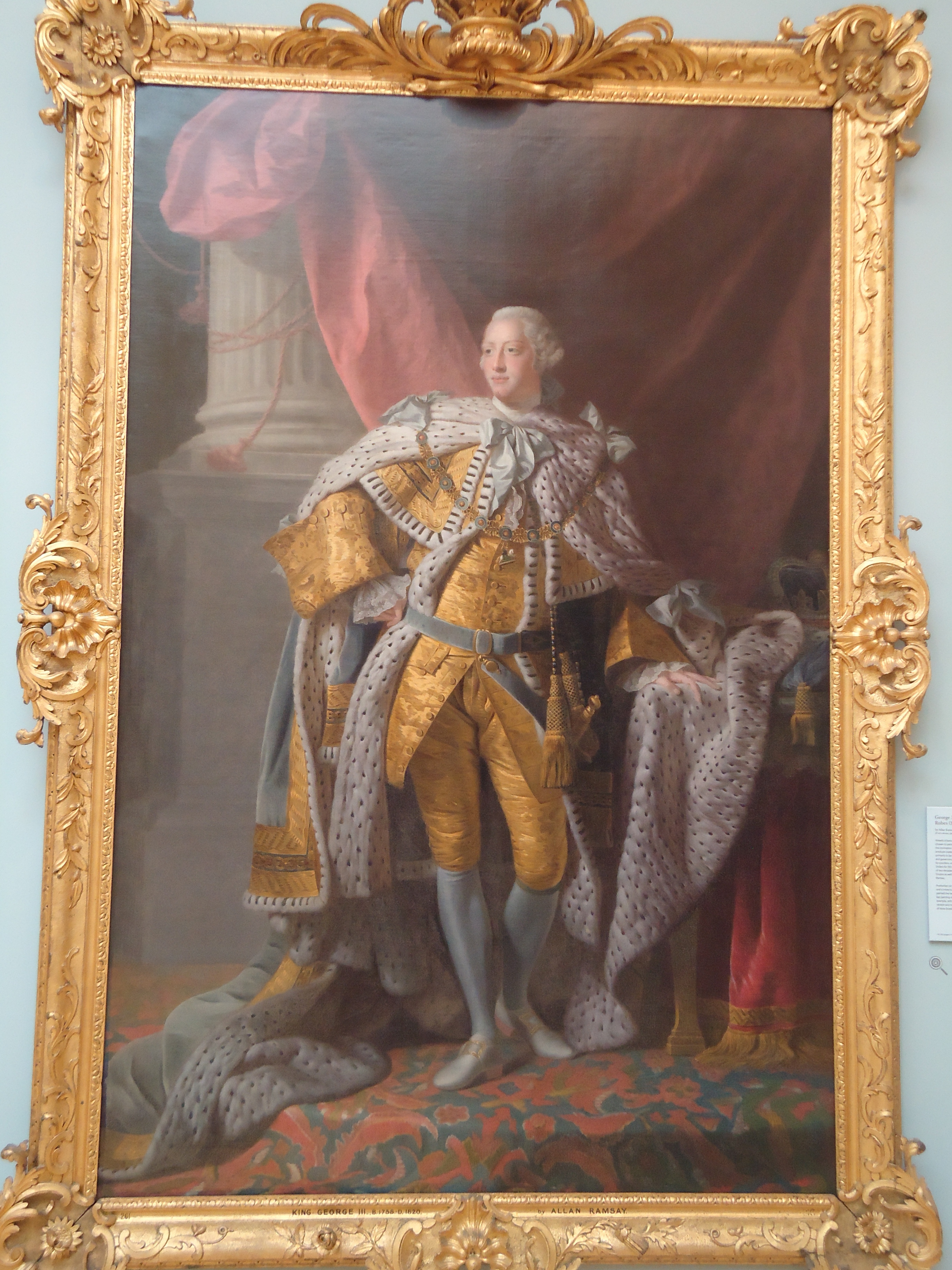
George III by Ramsey c.1763 - HandBound Costume, national portarit gallery of scotland, costume research, a look into goergian court wear, made to measure eighteenth century costume
Here is the second in the matching pair of the Coronation of King George III. Again, painted by Ramsey in about 1763.
Details include really deep and wide Cuffs, Stockings under the breeches which come just below the knee.
- Waistcoat in matching fabric with the buttons all done up down to waist.
- Coat appears to be caped with a shoulder cape and trimmed with ermine.
- Cloak is pale blue with gold border and oodles of ermine.
- Pale Blue stockings.
Below is a close-up of his breeches with a Button Fly.
Button Fly - George III - HandBound Costumes, Royal Portraits and their costumes, Breeches with button flies mid eighteenth century, men's historical costume and georgian costume, mens breeches and how they were cut and sewn and worn, 18th century made to measure costume research

Earl of Morton and Family - Davison - 1740 - HandBound Costumes Research, family paintings from the 1700's, clothing worn by women and their children, an example of a child with a doll, a boy in skirts and the eldest breeched, georgian clothing researched into by handBound Costumes, custom made replica clothing for reenactments or theatre,
 Details:
- This above painting is of the Earl of Morton with his Family. It is by Jeremiah Davidson and was painted in 1740.
- Some interesting features include an example of a boy in skirts before he was breeched ( a lady at the Scottish Collections Centre suggested this was about 4-6 years of age). He is the second in on the right and is handing his older brother an arrow. He also wears a kind of jacket over the top with elaborate frogging. His brother has a collarless jacket on and a nice example of a functional button-cuff.
- The middle girl is holding a sweet and rather clear example of a child's doll and also has the top of a red shoes slipping out from beneath her gown.
- The Mother wears what looks like a Round Gown and a cap with lappets that are pinned under her chin. She has a treble pinched grown on cuff and rather plain ruffles.
- We have some close-up details of this painting coming in a future post or viewable on our website (it's not been done yet but we're getting there!)
James Boswell - Willison 1765 - HandBound Costumes - National Scottish gallery Boswell, eighteenth century costume research, men's historical costume made to measure georgian clothingJames Boswell - by George Willison 1765.
Interesting Details:
- Another example of this fashion of not fully buttoning up the waistcoat around the waistline area and having a tuft of shift sticking through it. This is visible on more than just one portrait and therefore less likely to be just an accident. However it could be a standard way for artist's to show it as a relaxed portrait rather than a stiff, formal one.
- He has a Tricorn hat in his hand, a fur lined jacket and maroon breeches and matching waistcoat with gold trim and buttons.
- Black Cravat with a high-necked collar shirt.
The Old Pretender James III by Monaldi in July 1747, HandBound Costume research, Made to measure historical Costume, Jacobite clothing research, Eighteenth Century Historical Costume Research and bespoke garments, wide pannier dresses, robe a la francais and the wide side hoops, court wear for the mid 18th cent and 1747, Royalty and what they wore, close-up and details of paintings form the Georgian period, Costume in paintings from the eighteenth century, what the Georgians wore, Custom made 18th century costume, rococo dress,
Details:
-  James III Congratulating His Son Henry as Cardinal by Monaldi, Pubalacci, July 1747.
- We've actually done a whole page on this painting because, although it doesn't look that big here, it's actually massive and the crowd contains a whole realm of detail of costumes. Please click on this link here if you wanted to see the close-ups on 'A Study of a Painting: James III by Monaldi - 1747' which is situated in our  Customer Library on our website at http://handboundcostumes.co.uk/customer-care/customer-library/study-of-a-painting-james-iii-and-his-son-henry-benedict-monaldi-pubalacci-and-silvestri-july-1747/
- Wide Pannier Robe a la Francais Dresses, Rome fashions with striped headdresses and examples of Plebeian costume, all within the crowd.
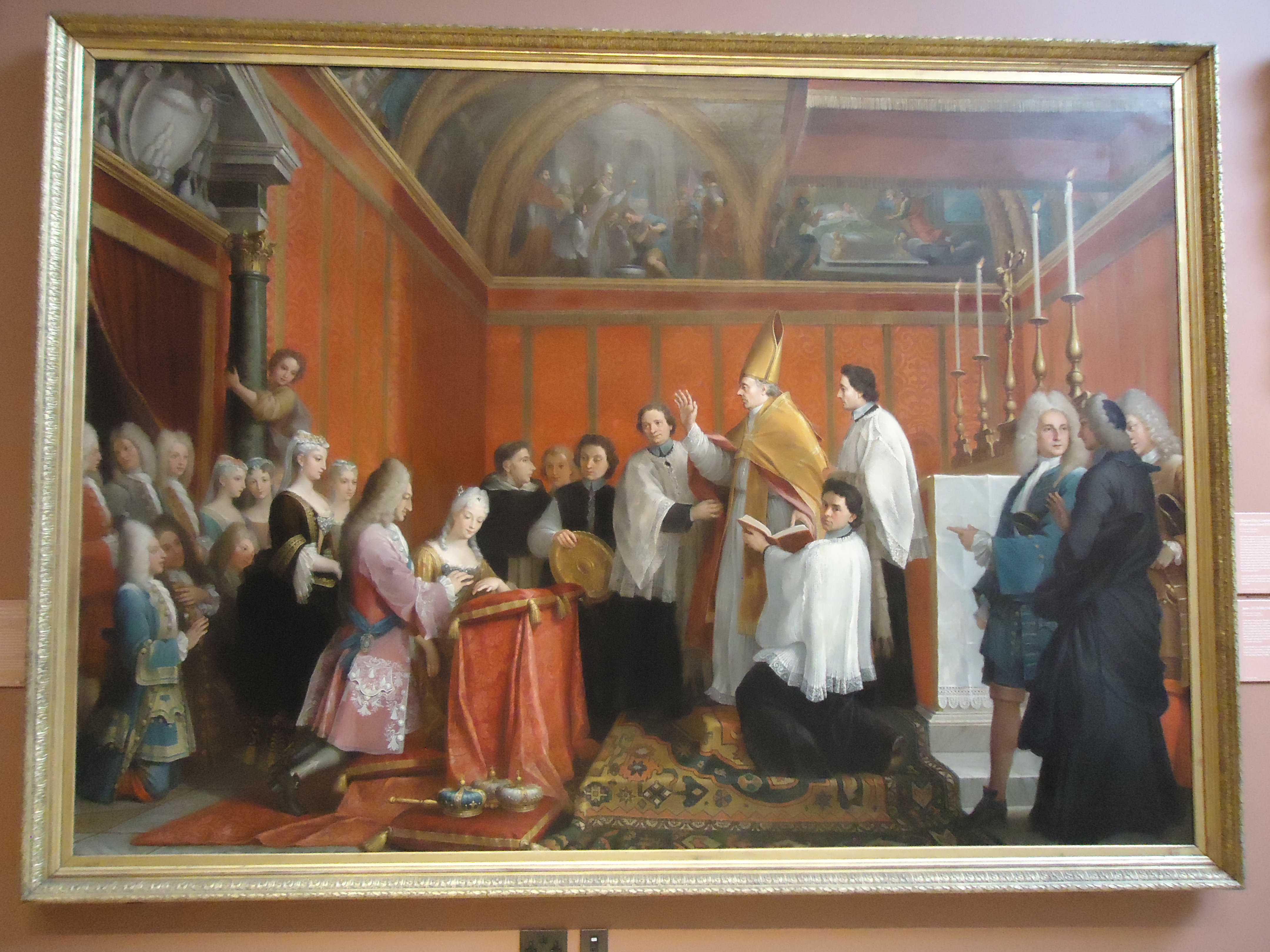
Baptism of Charles Stuart - Antonio David - 1725 - HandBound, historical costume research into 18th century fashion, 1720's costume images, Bonnie Prince Charlie Stuart christening,  mob cap with lappets images from georgian headdresses,  clocked stockings and examples of ceremonial colours and fashionable colours for stockings,  examples of georgian mens costume in early 1720's, womens costume in early 1720's, made to measure period clothing, historical bespoke costume
The Baptism of Charles Stuart - Antonio David - 1725
Details:
- Here are some prime examples of caps with long, narrow and straight lappets. The only ladies that are wearing caps are on the left hand side of the painting, behind the Clergy. I don't know if there is any siginificance to this or if it is just chance but all the ladies here are wearing two-layered caps with two layers of lappets.
- We've got some close-up studies of this painting in our Customer library entitled A Study of a Painting: Baptism of Charles Stuart - please click on this link and take a look at our notes and the details of the costumes of the ladies behind.
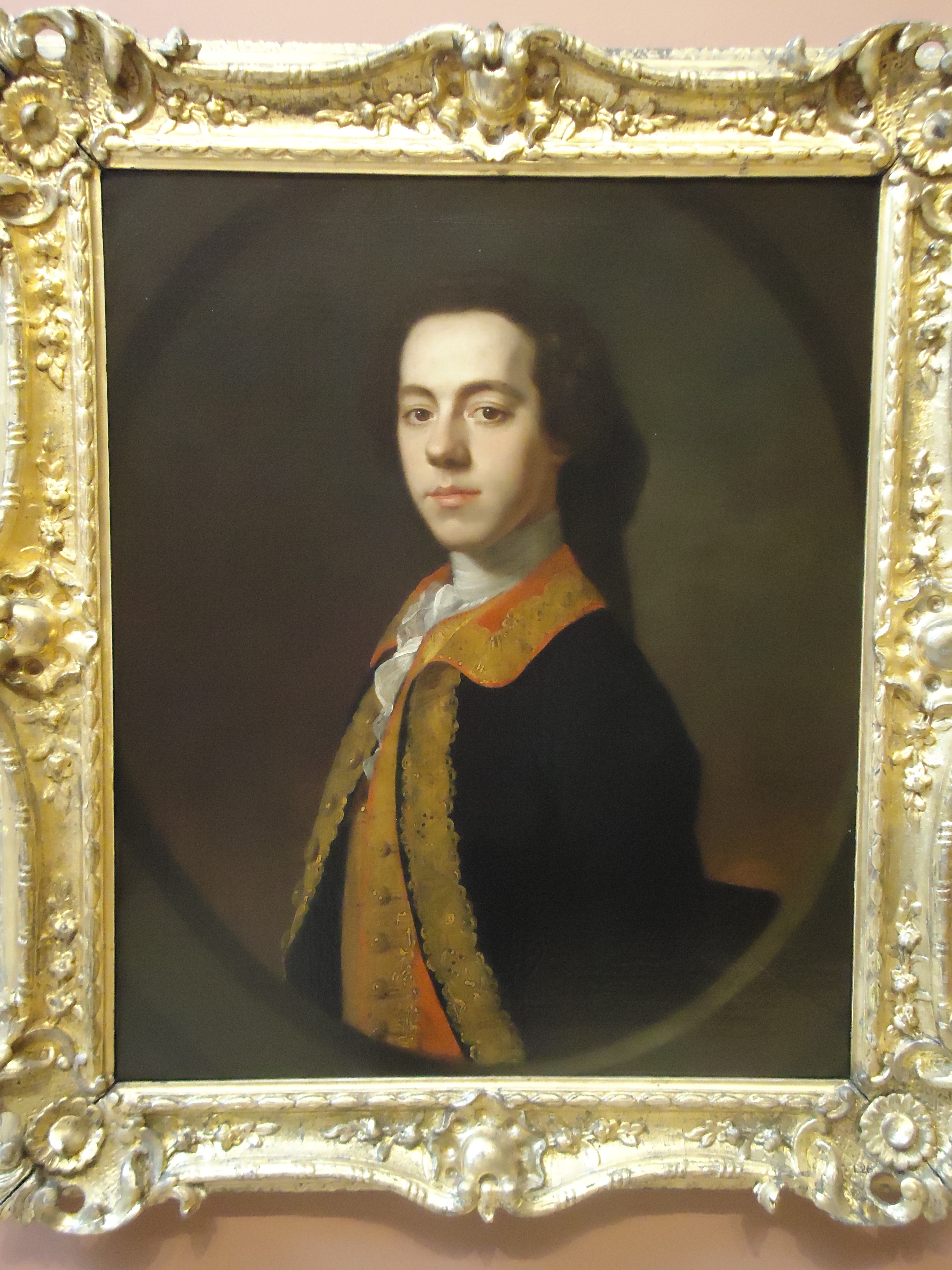
Alexander Murray of Elibank - Ramsey - 1742 - HandBound Costume, Mens georgian costume research and images, mens styles of fashion throughout the eighteenth century, historical tailored costume, Bespoke Tailored Georgian Clothing
Ramsey - 1742 - Alexander Murray of Elibank
Details:
- High neck cravat wkith frill hanging down.
- Possibly natural hair styled similarly to a wig.
- Black Jacket with Red Fcaed collar and gold braid/embroidery.
John Campbell - 4th Earl of Loudoun - Ramsey - 1747 - HandBound Eighteenth Century Costume Research, Close-up study of painting, mens fashion in the 1700's, mid-eighteenth century mens costume, bespoke historical and period costumes for men
John Campbell - Ramsey - 1747
Details:
- Nice example of the looser sleeves that tightened as the years went on.
- Finer braid, white wig and with a hat tucked up under his arm. Also wears high-necked white cravat with frill.
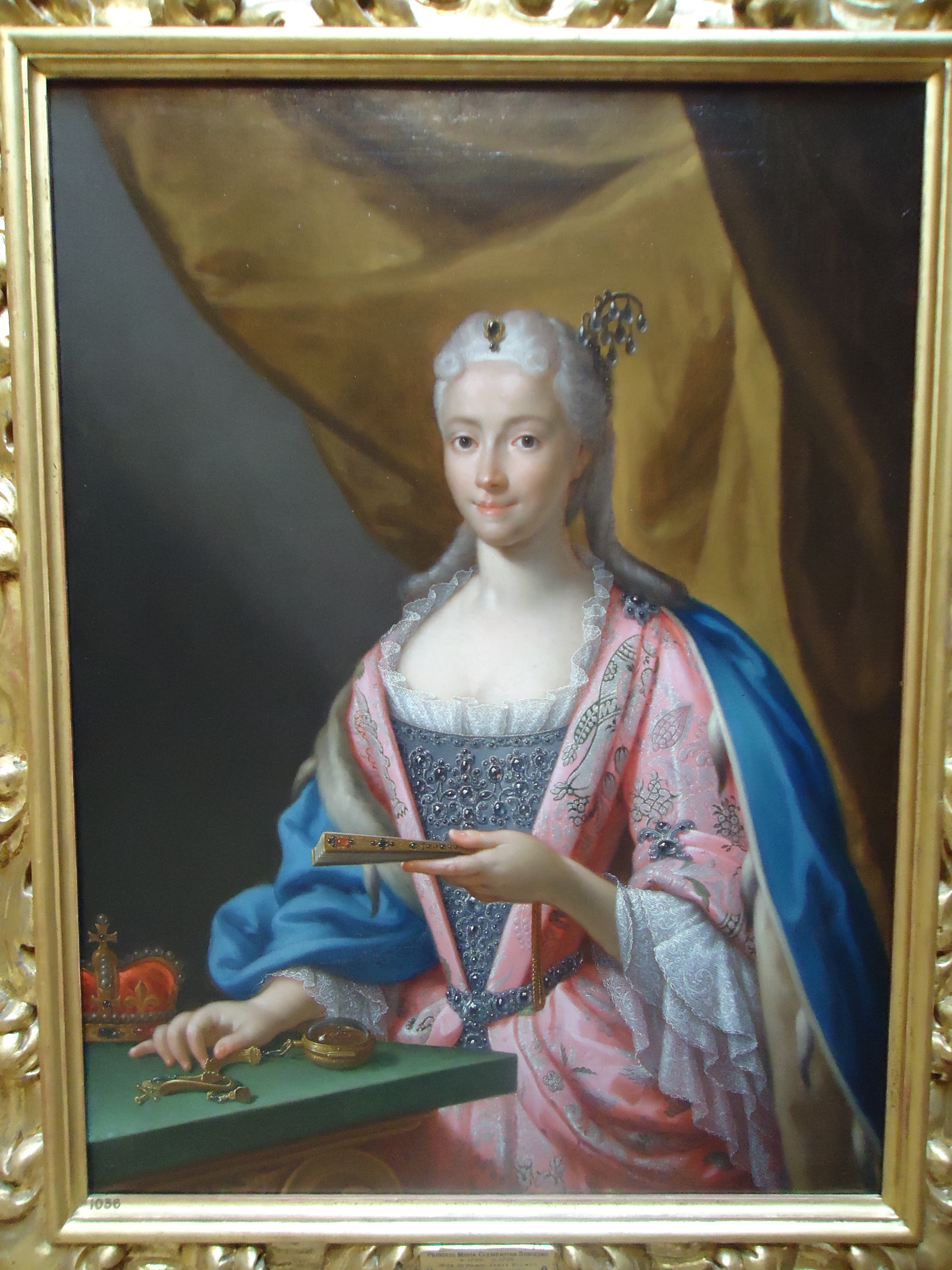
Maria Clementina - by or after Trevisani - 1719 - HandBound Costumes, 18th century court fashion and royal portraiture, Stiff bodied gown and early 18th century costume, court mantua with stones,
Maria Clementina - Trevisani - 1719
Details:
- Floral silk Soft-Bodied Mantua Gown over Stiff stomacher beaded with stones. Belt round waist is also set with stones.
- In these dresses you can easily see the development of the Anglais and Francais robes, the robings and the skirt sections are all incredibly similar to later on in the century.
- She has two layers of lace ruffles under her sleeves and the gem on the indent of her elbow is possible a broach that holds the pinch-pleated cuff together.
- Museum's notes say powdered hair not wig and there appear to be ermine tails on the edge as a tassle of her cloak.
- This tree of dripping stones, as a way of describing it appears in a few portraits and in fact include another image in the same museum. We wonder if it is more of a catholic country fashion as the Scottish were closely catholic at this point and England were following more Dutch fashions at this particular point of time.
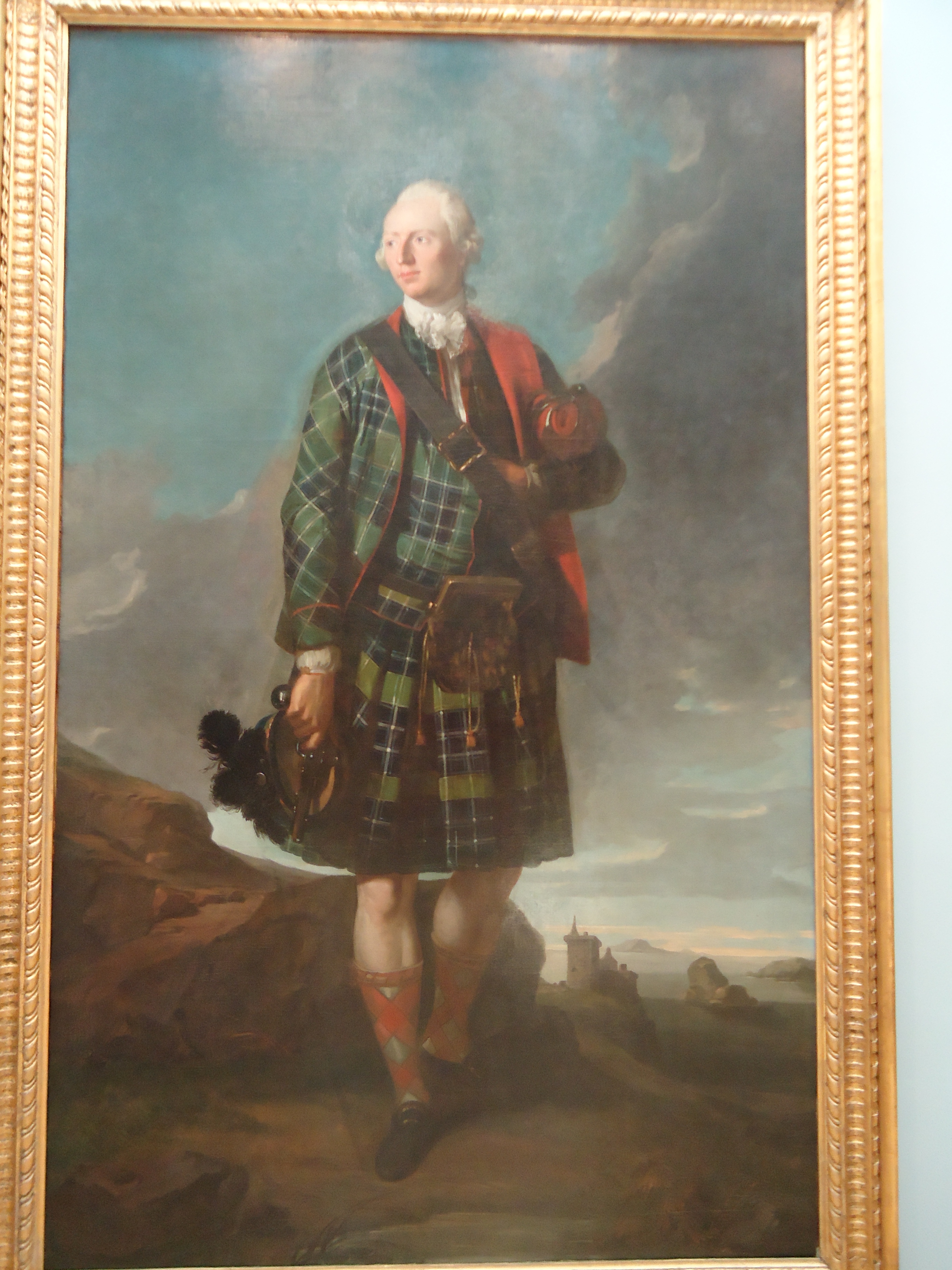
Sir Alistair MacDonald - attr Chalmers - 1772 - HandBound, late 18th century example of Scottish plaid in historical costume, mens historical costume, history of the kilt,
Sir Alistair MacDonald - attributed to Chalmers - 1772
Details:
- These are great images. It was a real pleasure to be able to see such large portraits showing kilted suits. Here is one of those images and this portrait was atleast 1.5 mts in height.
- Here the jacket takes on the more cut-away look of the late eighteenth century.
- We're not too of-fay with kilts and the particulars worn with them and dates of when such items came into popular use are unknown to us, but here he wears a Sporran, has either plaid stockings or strapped up looking laces.
- Ruffle-less shirt sleeves, high cravat and frill, short waistcoat trimmed with red (what looks like) piping.Red Faced jackets which at this stage is kind of the beginning of the lapel.
- He carries a hat in tartan and a gun in his right hand and a 'no idea what' in his left.
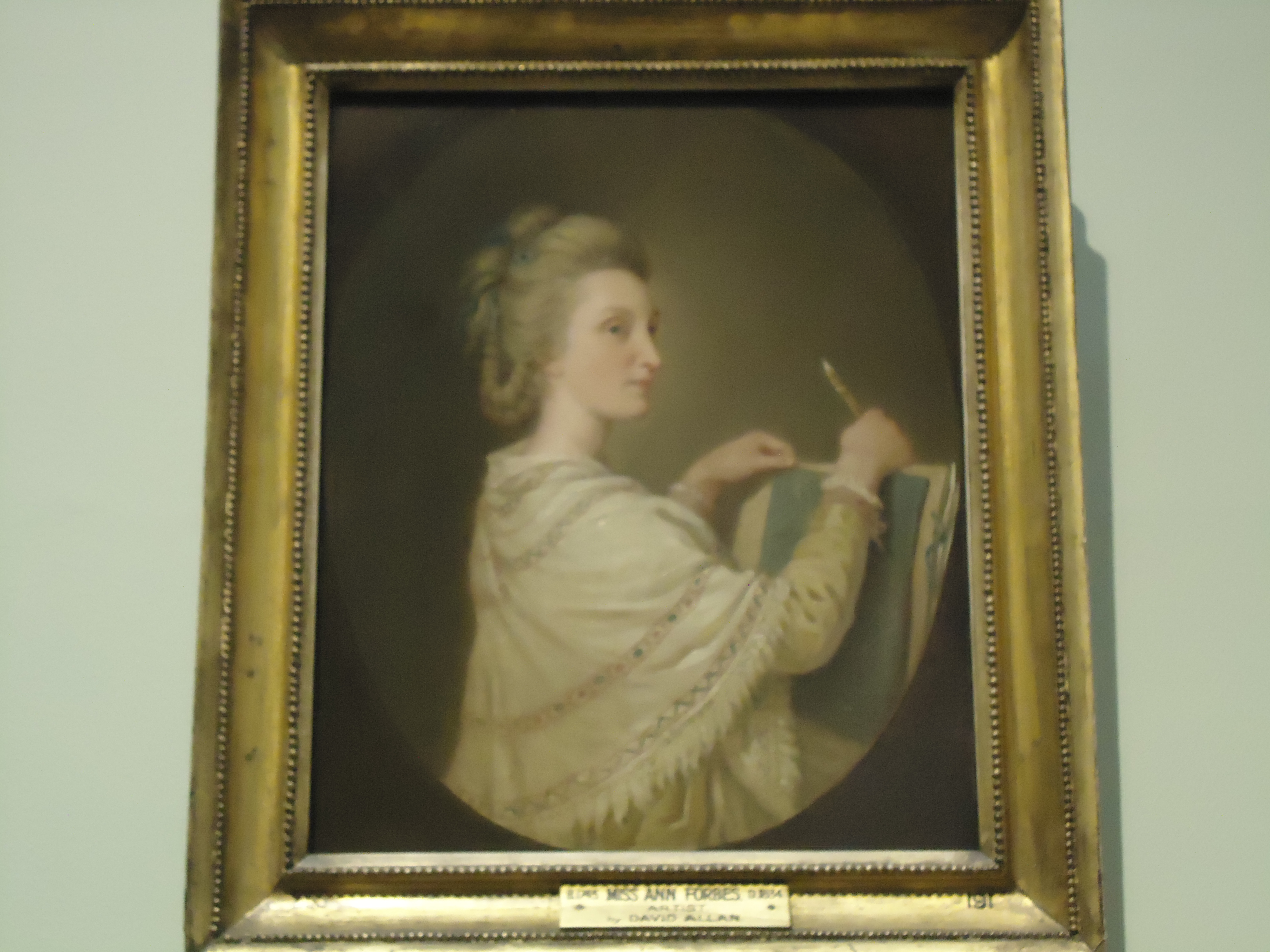
Ann Forbes - David Allan 1781 - HandBound Costume, womens eighteenth century costume research, portraits of fashion for the 1700's, 1780's fashion
Anne Forbes (1745-1834) by David Allan - 1781
Details:
- Anne Forbes, according to the museum's notes was a painter who studied in Rome but on returning didn't quite make it in setting herself up as a portrait painter. She settles for being a drawing teacher which was considered a more appropriate role for a woman.
- Here's she's depicted wearing quite a distinctive shawl. It has a fringing edge - probably long fur and liens of decorative trim.
- Her hair is also quite clear and distinctive - with the large plait coming up from the bottom - and natural.
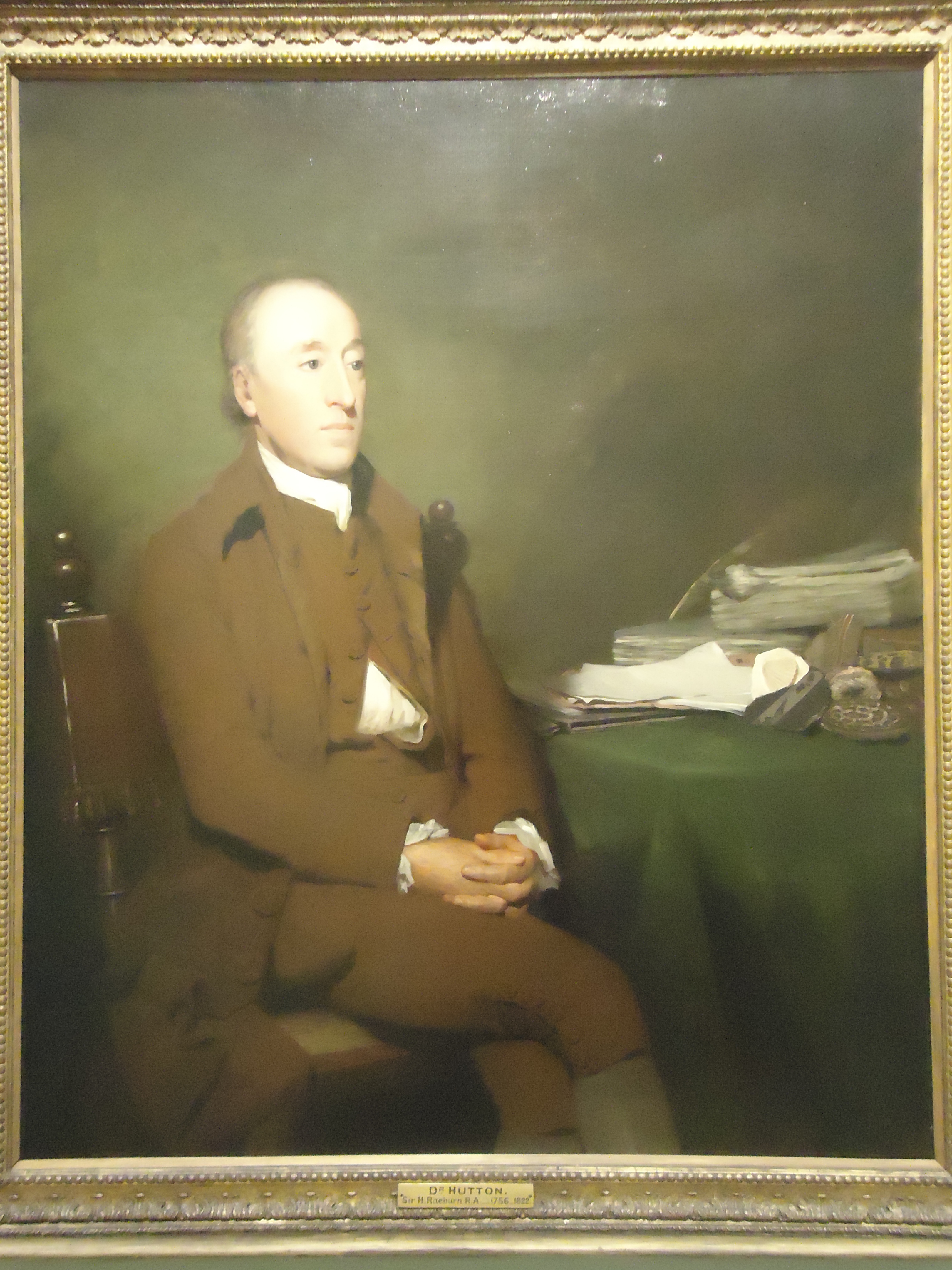
james Hutton - Raeburn - 1785-90 - HandBound Costumes
James Hutton by Sir Henry Raeburn - 1785-90
Details:
- James Hutton is considered to be the founder of the study of  Geology. His portrait here shows some of his Naturalistic interests.
- His three piece suit appears to be all the same fabric and colour with his breeches buttoning uite high with fairly small buttons and a narrow leg.
- His jacket has a Collar and no cuffs and the sleeves are also quite narrow.
- Again we have this buttoning up of the top part of the waistcoat and then down below the waist and with the shirt showing through the middle.
- He wears no wig but as the notes say; this derives from a relaxed portrait with him in his study and as he would be.

Wednesday, 7 May 2014

Ruby Silk Robe a l'Anglais

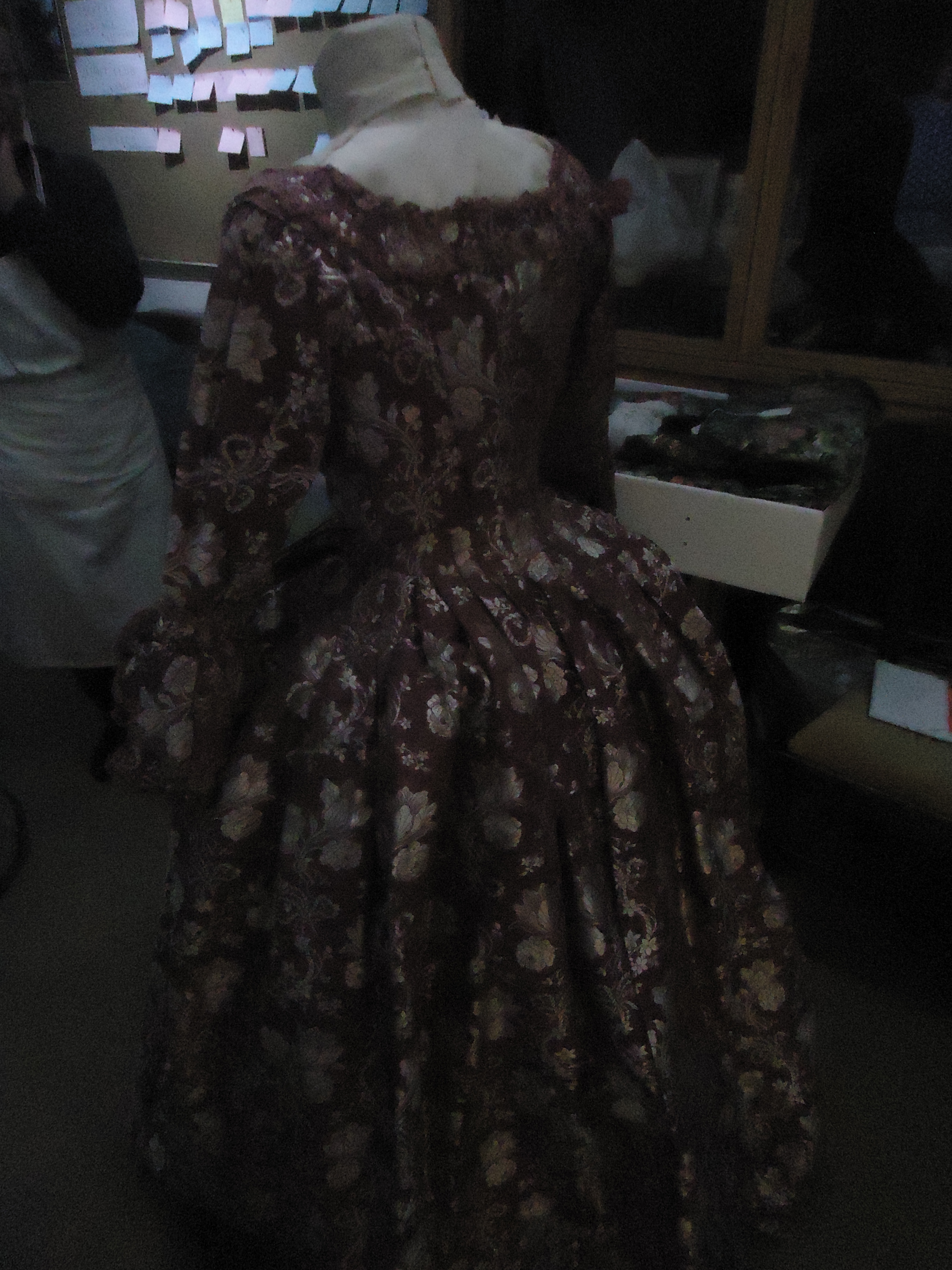
A Robe a l'Angais of Ruby Silk:

c.1760

(All these images are used with permission from the Totnes Fashion and textile Musuem)
HandBound Historical Costume research, 1760's robe a la anglais, how a robe a l'anglais was sewn, georgian 1760's sack back in ruby silk, a study of a 1700's robe a la francais from the totnes fashion museum, images from original garments, examples of sewing techniques used in the eighteenth century, georgian sewing methods, furbellows and how they were made, ruching and early examples, fly trim, ruffled cufss from the late 1700's, 18thc dress in study, 18th c costume and dressing like the duchess, antionette style, mdm pompadour and what she would have worn
Front View
Ruby Silk Robe a l'Anglais.
c.1760
Details:
- Open Gown with both open bodice to reveal stomacher/stays and open gown to reveal petticoat.
- Robings either side and decorated with furbelows.
- Furbelows also trim down the CF skirt and around the cuffs
- Furbelow is quite tight with fabric, being very mean with the gathers and comes across almost flat. Fly trim decorates either side.
- Bodice is linen lined.
- Two tiered ruffle cuff with fly trim at the end of each ruffle.
- Ruffles sewn onto sleeve leaving a band on the inside for sewing flounces or lace ruffles onto.
- Furbelow trim is same depth at back neck as on front.
- Bodice has dart at front and then a two panelled back with CB panel going into the skirts.
- No Pocket openings
- Robings fold Herringboned Stitched down.
- 1/4 Inch raw selvedge seams.
- Furbelows sewn down with a Stab stitch.
- Petticoat has a curved hemmed Trim.
- CB Pleats have been Stab stitched down
HandBound Historical Costume research, 1760's robe a l'anglais, georgian 17660's sack back in ruby silk, a study of a 1700's robe a la francais from the totnes fashion museum, images from original garments, examples of sewing techniques used in the eighteenth century, georgian sewing methods, furbellows and how they were made, ruching and early examples, fly trim, ruffled cufss from the late 1700's, 18thc dress in study, 18th c costume and dressing like the duchess, antionette style, mdm pompadour and what she would have worn
Back view
We know these photo's appear quite dark but the lighting is specially designed to protect the cloth and obviously a flash wasn't allowed. But we believe you can still see the details clearly - enough to be able to learn from them.

HandBound Historical Costume research, 1760's robe a la francais, georgian 17660's sack back in ruby silk, a study of a 1700's robe a l'angais from the totnes fashion museum, images from original garments, examples of sewing techniques used in the eighteenth century, georgian sewing methods, furbellows and how they were made, ruching and early examples, fly trim, ruffled cufss from the late 1700's, 18thc dress in study, 18th c costume and dressing like the duchess, antionette style, mdm pompadour and what she would have worn
Out on the table
What we have following are images of close-up parts of the gown while it was on the table awaiting to be dressed onto the mannequin. In the above image you can see the furbelow trim edging the robings and the skirt and you can see the lined bodice and pleated top of the skirt.
ruby silk robe a l'anglais, english gowns and robes, musuem collections online, construction techniques into making a robe a l'Anglais, HandBound Costumes historical sewing techniques research,Robe a l'Anglais, Goergian dress from the museums, Examples of furbelow trim, pleating of skirts, ruffled cuffs and robing methods, georgian dress, eighteenth century costume from museums, custom made HandBound historical costumes, replica period clothing, reproductions costumes for reneactments, bespoke historical garments
Sleeve Detail
The amazing thing when you study and visit these dresses is sometimes, however mind blowing the fabric is and the excitement of seeing something 200 years old, you can still get an idea of when a dress was quickly or slightly more on the cheap. This is a fairly simple example of a Robe a l'Anglais, fairly slim on the CB pleats, mean on the trim and basic in the pleatage system around the waistline of the skirt. You can well imagine the lady putting most of the money into the fabric and not having much left to pay the tailor.
Here's an example of the way the sleeve has had the ruffles sewn on, leaving the band beneath. As you can see the Ruffles have been sewn down higher up onto the sleeve, leaving this protrusion that can be used to sew the lace ruffles onto.
construction techniques into making a robe a l'Anglais, HandBound Costumes historical sewing techniques research,Robe a l'Anglais, Goergian dress from the museums, Examples of furbelow trim, pleating of skirts, ruffled cuffs and robing methods, georgian dress, eighteenth century costume from museums, custom made HandBound historical costumes, replica period clothing, reproductions costumes for reneactments, bespoke historical garments
Sleeve Furbelow close-up
To the left here, is an image showing in close detail the size and gathering of the furbelow with Fly Trim. the Fly trim has been applied much more generously and the Furbelow much tighter gathered. I wonder why really, was it that the sleeves were a particularly noticeable spot? I can't see them being any more noticeable than the whole front of the dress. Or could it be that in the pattern cutting it was easier to get a these tinier strips out than it was for the wide and longer lengths needed for the front trim?
I obviously had a relatively short time and between taking photo's, helping hold doors open and taking super-quick sketches, there wasn't really loads of time for taking measurements and such.
I'm going to include my rather bad sketch and notes of this dress aswell as it may help complete the picture and I dare anyone to be able to read my scribbled notations. When I sketch I always think, 'this drawing is not so important: I have the photos as the main records' but then when I see the photos I think 'what I need is my drawings with all the notes arrowed in'. But I hope you find both of them useful.
Here's a quick image of how flat the Furbelow trim at the front of the dress looks (please look right):
Totnes Fashion Musuem, Red 18th century Dress, Brocade Silk, Georgian Costume Research, What the Duchess wore, Eighteenth Century Clothing, Dress and Undress, Robe a la Francais, HandBound Historical Costumes Research
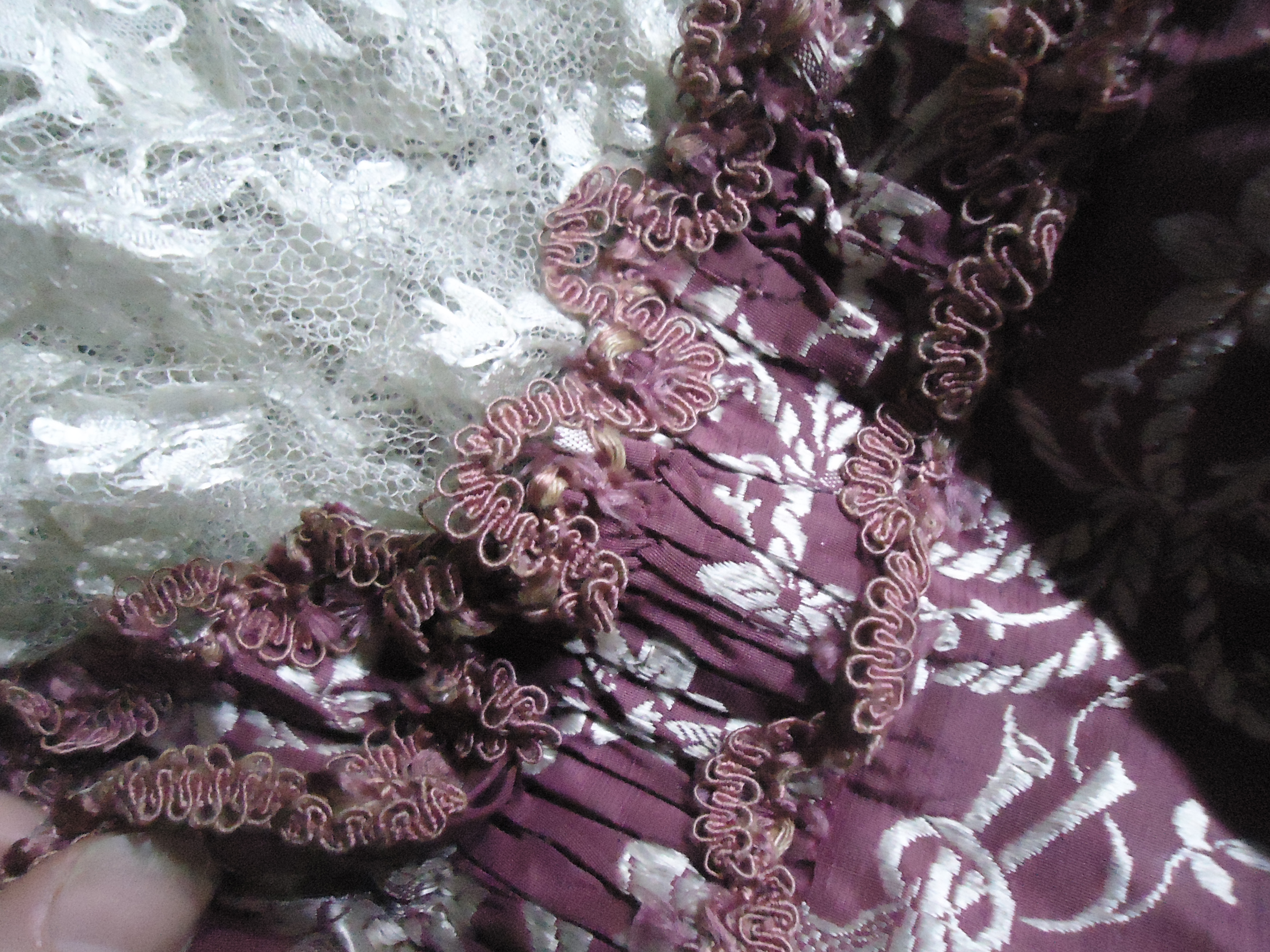
- This next image is a close-up of the top of the Bodice and shoulder including a detailed shot of the Furbelow and Fly Trim. You can see the stitching even from this photo, see how the Fly Trim has been gathered up and set into curves - It's like they've pulled one thread and then held it into place by catching it down. And see the barely-gathered Furbelow, the centre run of stitching and other stabbed stitches holding it in place. these Stab Stitches were done from the other side, creating a large running stitch on one side and barely noticeable pricks of a stitch on the other. The way we learnt it at the Tailor's was you had your hand on the Right Side of the garment (tiny stitch side) and you sewed into your finger almost, using the cushion of your finger tip to tell you how far you had come out. It is the same technique used in Padstitching collars. You can also see from this image the stitching used to hold down the CB Pleats typical of Robe a l'Anglais. This is a clear example of the stitching just mentioned above as the running stitch that we see here is coming out the other side as a tiny catching of the fabric.
Totnes Fashion Musuem, Red 18th century Dress, Brocade Silk, Georgian Costume Research, What the Duchess wore, Eighteenth Century Clothing, Dress and Undress, Robe a la Francais, HandBound Historical Costumes Research
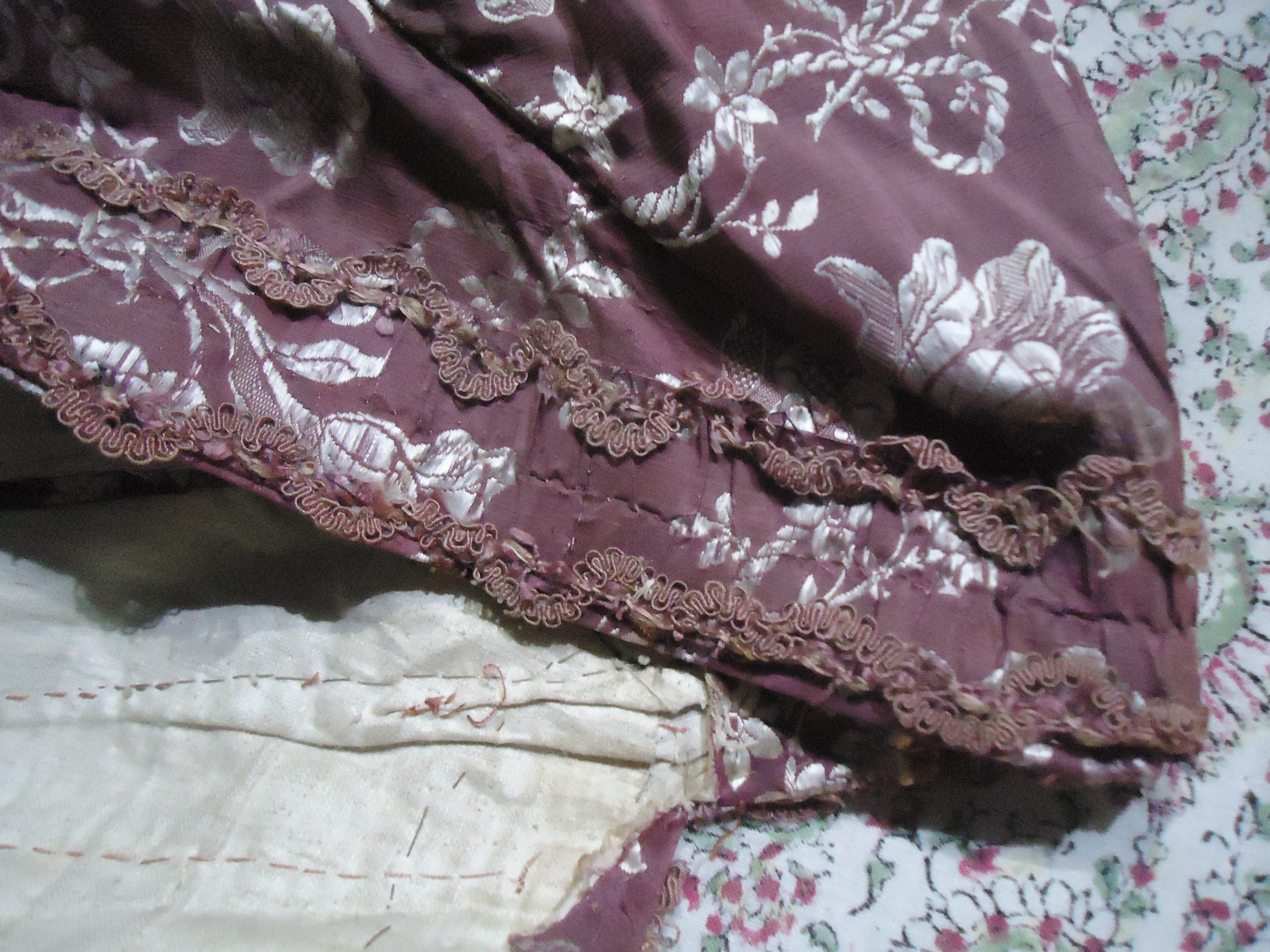
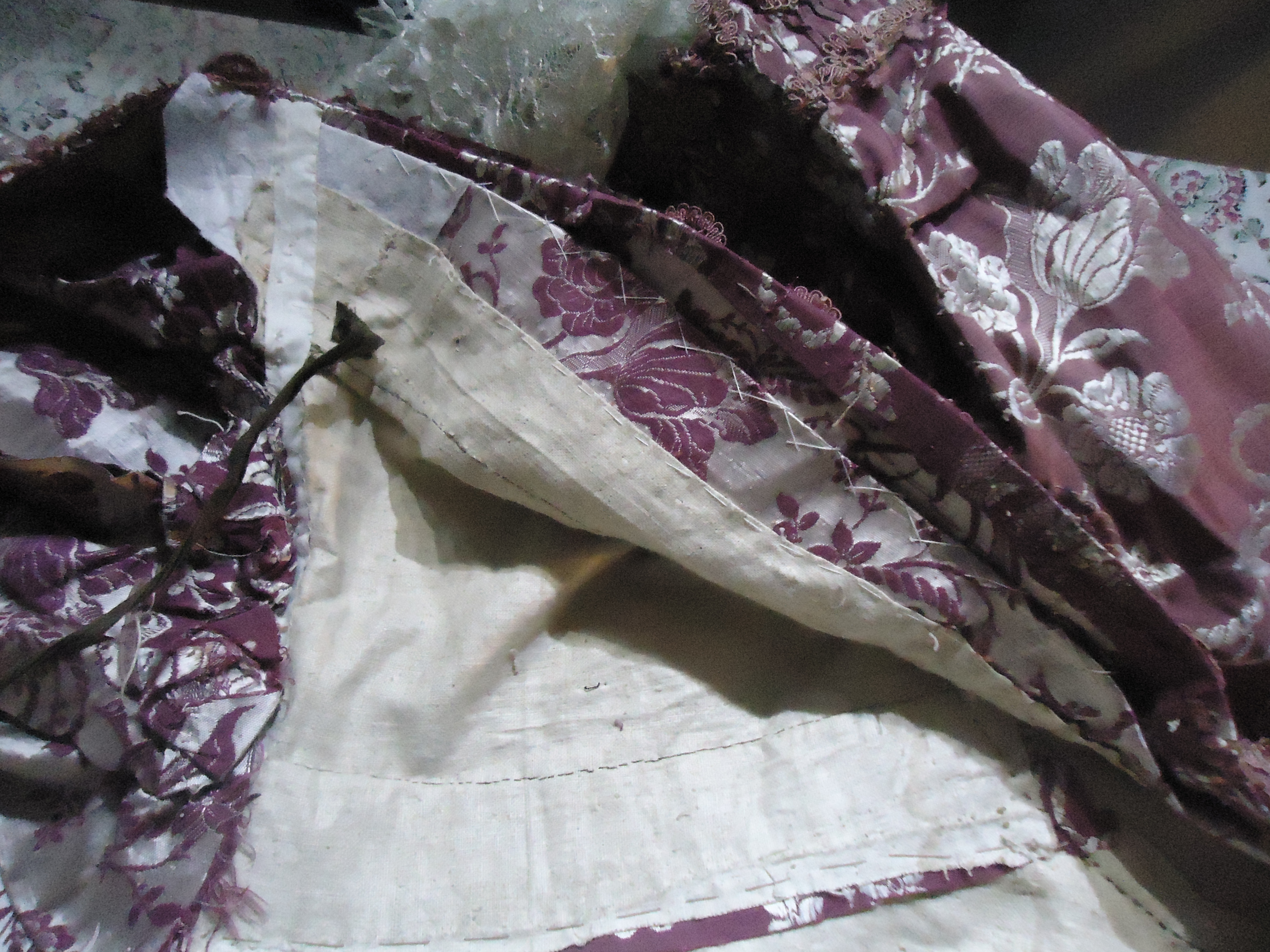
You can see here from the above image how the robings have been sewn down. This in itself is an amazing example of both how logical the Eighteenth Century Tailoring was but also how practical and functional.  You can see in this particular dress that it was a) Grown on and b) folded to the right specification and held there by the herringbone stitch and c) alos only had a small turn back for the centre front facing. The lining doesn't even come up to it! You just see this bare fabric turned back with what could seem like a sloppy raw edge. From a previous trip to the Totnes Fashion Museum, Julia Fox had said something that just clicked so much into place for me when looking at eighteenth century dresses. She said the reason why they left the additional corners of fabric that they didn't need, for example, in the pleating curve of the front fall of the skirt, was that if the dress was unpicked and ironed back out flat, there would still be as much as possible large squares of the original fabric. This meant that you could much more easily re-make it or use it for a different purpose. To me, that's just wonderfully logical. This logic could be followed through into the grown-on robings and the way the sacks were sewn down but kept in the Robe a l'Anglais'. You can see some of this raw edge, excess fabric in the gathered section of the skirt in the above image. It's not there in abundance but the amount of what we would call 'seam allowance' in the seam of pleats is clearly large, raw and fraying only just slightly after 200 years. Nowadays this would've been cut to each pleat and overlocked off and hidden by the lining.
Totnes Fashion Museum, Red 18th century Dress, Brocade Silk, Georgian Costume Research, What the Duchess wore, Eighteenth Century Clothing, Dress and Undress, Robe a la Francais, HandBound Historical Costumes Research
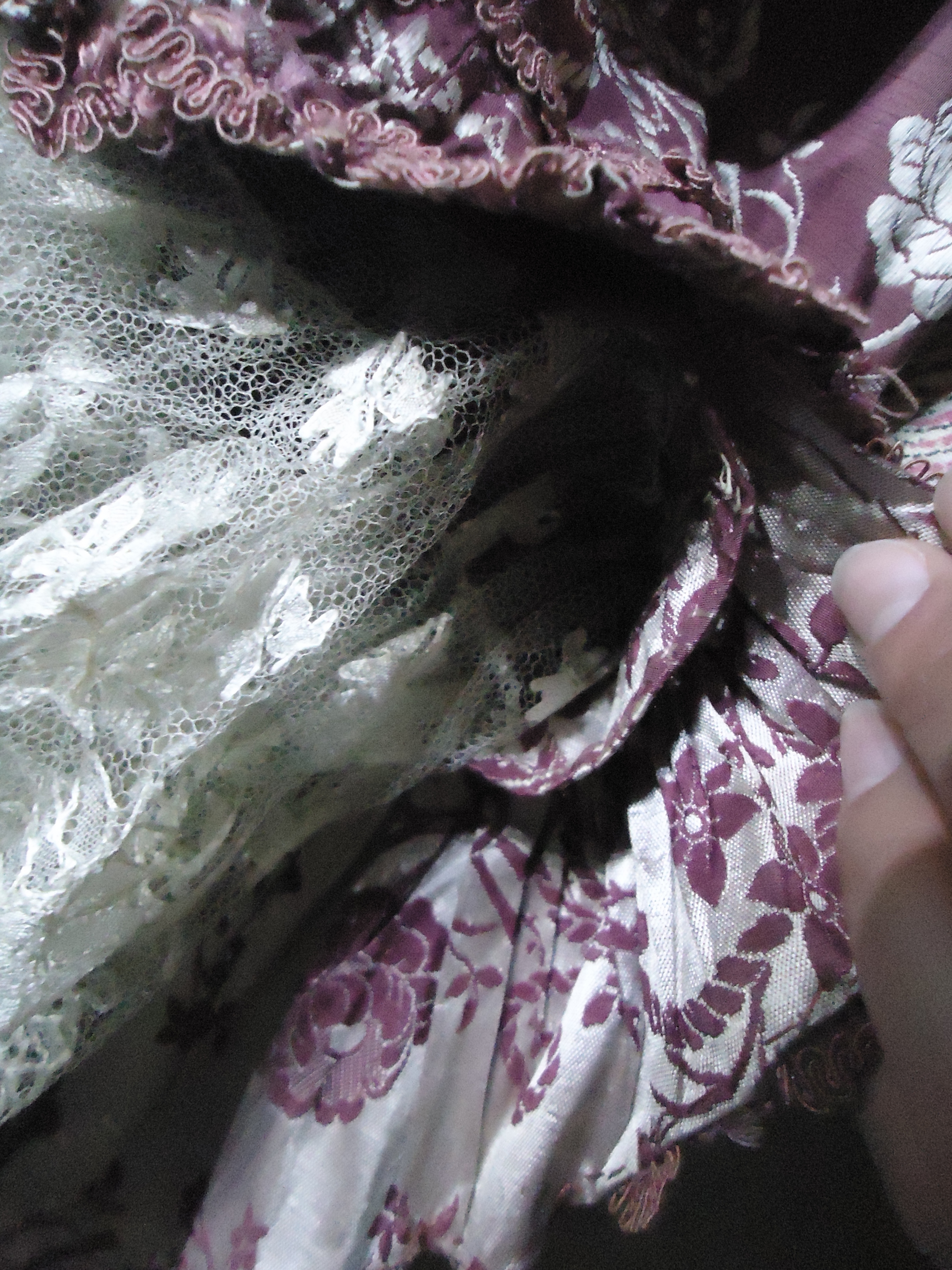
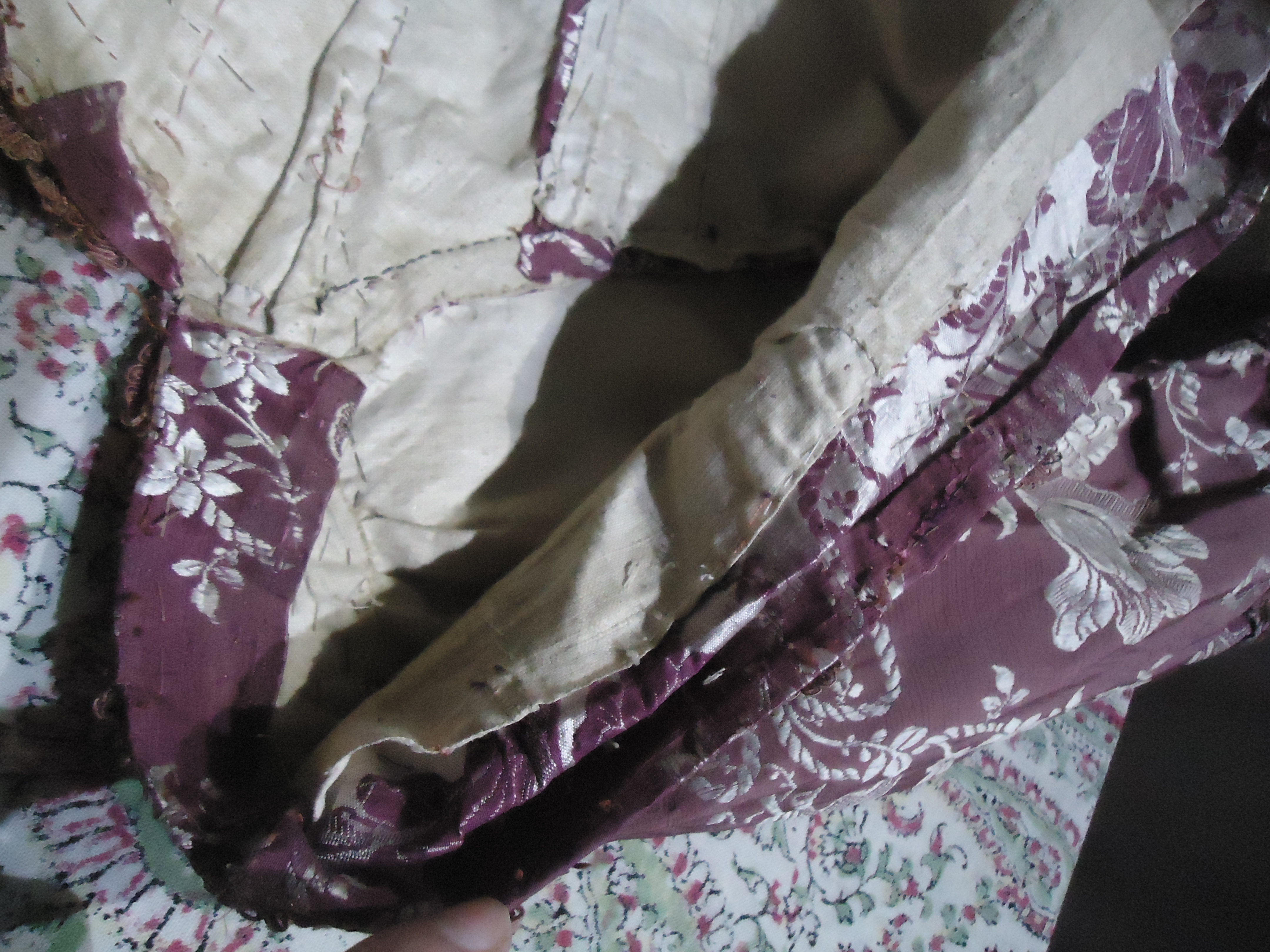
This image above here may look upside down and it probably is, but the whole detail of it is looking down from the top right hand corner of the dress, down into the front robing that is being held out by the finger, but also down into the back section of the dress and seeing the shoulder band, the sleeve lining and the scye seams. There are many interesting details in this photo. You can see the pin holes from pinning down the robings travelling along the inside of the cf Robing as held out by the finger. You can see clearly the large tacks that were holding down the furbellow trim, and the amount of what looks like random large stitches in the sleeve lining of the crown and the lining of the back. These stitches weren't arbitrary. Modern day tailoring has been developed to hide as much of the inner workings as possible. Less visible stitching has been encouraged when sewing in a way that will be seen, and the lining has been designed to hide as much of it as possible. It's hard to look at stuff like this and not think it was a rushed job, or that they were being sloppy. And it's hard for us when trying to replicate a garment for selling, to not use these newer techniques for the neatness of our garments - we know we do it here at HandBound. A part of me would like to work through the same sewing process they worked through and experience it. There's always so much more research to do! A part of me loves the idea of making up a garment completely using their techniques and beholding the raw edginess of it all in all it's glory.

Monday, 28 April 2014

Grand Georgian Ball Outfit

Mr Peacock's Outfit of Ivory Dupion:

18th century Costume - HandBound Costumes,,Georgian costume and dancing,
(The photo is also a Video Link - please click on it)
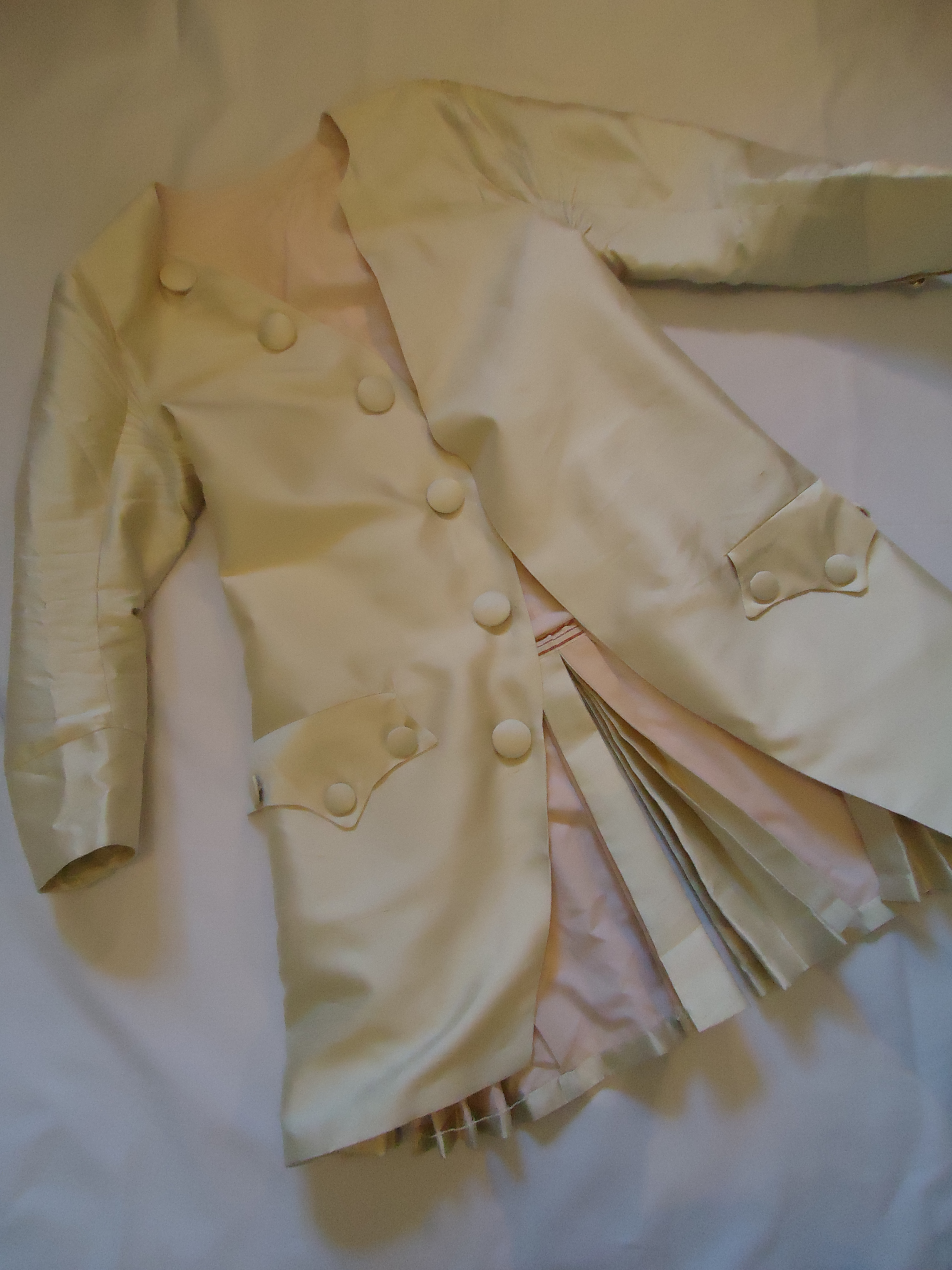
With the arrival of the last two tickets to the Grand Georgian Ball at the Guildhall in Bath, a sudden order was put in for a Drawing for 18th C Man's Three piece Dupion Silk Suit by HandBound Costumes, hand Made Georgian Costume, Made-to-measure Eighteenth Century Costume - Period tailoring, 1700's Men's tailored Costume, bespoke Historical Clothing, custom made georgian breeches, cutaway coat, dress coat, decorated waistcoat, covered buttons, late eighteenth Century dress, 1760-80's costumiers, talior-made 18th C. man's costume,
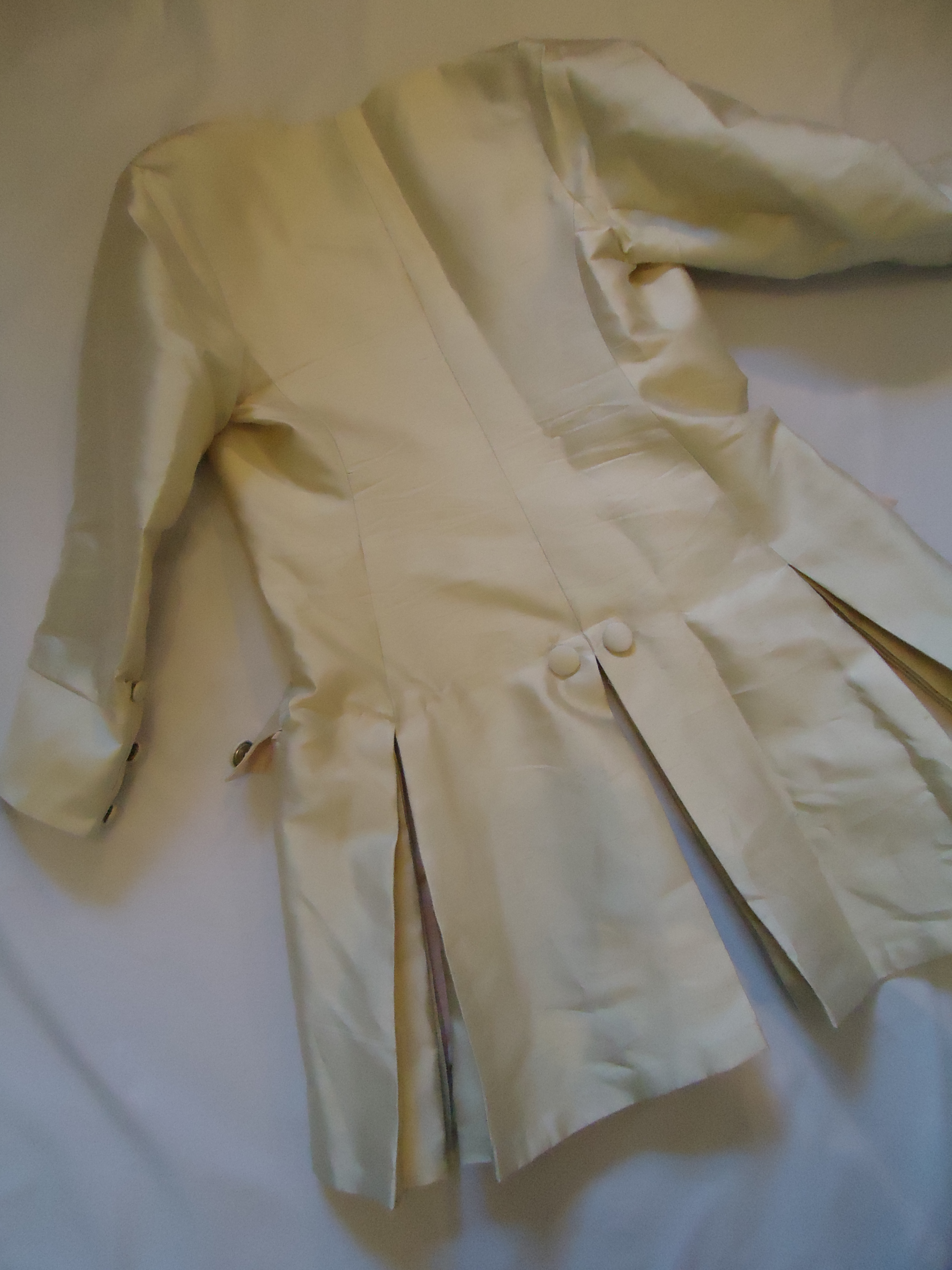
gentleman's eighteenth century suit of clothes. With only 2 weeks til the deadline, an old curtain was provided for the waistcoat (which actually looked pretty good in the end), measurements were provided promptly and a rather rushed session of Pattern Cutting was begun. Mr Peacock required a 3 piece suit with full length waistcoat and matching coat and breeches and had chosen a really nice solid-weight Dupion in Ivory.
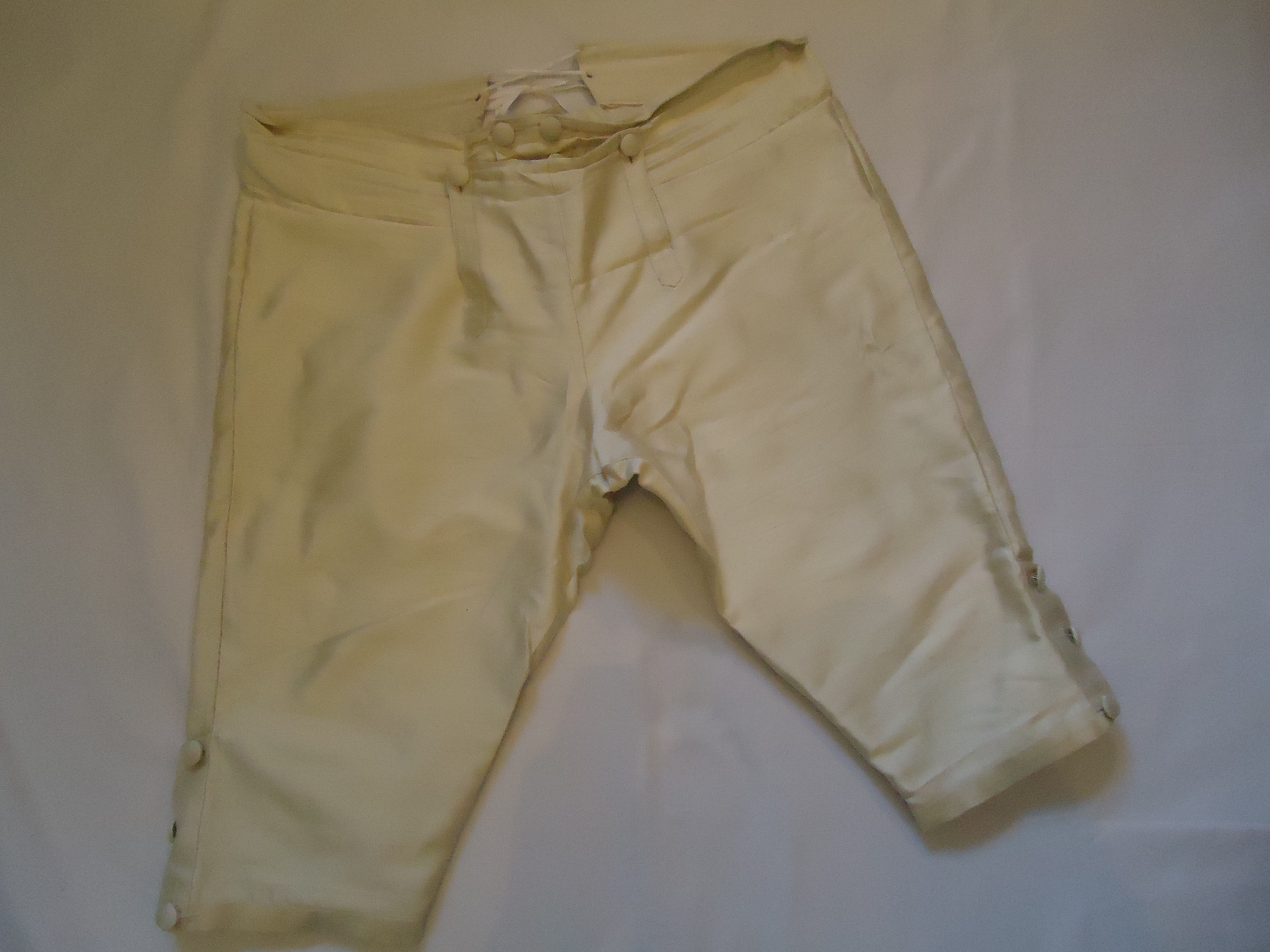
- The breeches were designed to be just below the knee based around the period of about 1760's - 70's and where they were getting slightly more streamlined and slim. They were small split falls with traditional plackets and fastened with a pair of covered buttons. the guards were left loose although historically
Man's 18th Century Suit - HandBound Costumes, 18th C Man's Three piece Dupion Silk Suit by HandBound Costumes, hand Made Georgian Costume, Made-to-measure Eighteenth Century Costume - Period tailoring, 1700's Men's tailored Costume, bespoke Historical Clothing, custom made georgian breeches, cutaway coat, dress coat, decorated waistcoat, covered buttons, late eighteenth Century dress, 1760-80's costumiers, tailor-made 18th C. man's costume, they could also be laced for a neater finished.
- The breeches also had a double-breasted waistband if such a term can be used for a waistband, containing 6 buttons and all covered in self fabric.  The breeches also had a lace-up section at the CB and the bands about the knee were also decorated with a shaped placket that matched the jacket. This placket was decorated with 3 cover buttons and only the bottom one, that sat on the leg band was functional.
- The waistcoat was designed to be long waisted and angled at the bottom point.  The pocket flaps were cut to the same pattern as the coats though were smaller in size and covered a fully functional pocket. The front of the w/c was run with buttons amounting to 10 and were fully functional - the button holes however,Man's 18th Century Suit - HandBound Costumes, historical clothing cut for a beer belly,  were not up to our best as they were just done on the domestic embroidery machine and lacked 'oomph' as it were. The fronts of the w/c were cut following historic techniques, to spread round to the back of the armhole. Where the fronts and the lining met at the hem, we left a  deep slit, again echoing original garments, and created the ends of the fronts into a sharp point so that it sat out over the lining and had a freedom to swing slightly. We double layered the fronts of the w/c to give it a more meatier feel and it had a lovely heaviness about it when we'd done.
- The coat was collar-less and slim cuffed with decorative placket that matched the breeches knee placket and lined with link cotton and striped sleeve satin lining. The pocket flaps were to be
18th C. Ivory Dupion Silk Man's Suit by HandBound Costumes, bespoke eighteenth century tailoring, hand amde eighteenth century historical garments, made to measure gentlemens georgian garments used as part of the design feature and were shaped similar to the plackets and decorated with covered buttons. The pockets were fully functional except the buttons. Large covered buttons also decorated the front of the coat but Mr 
Peacock opted for not having button holes due to expense and time.
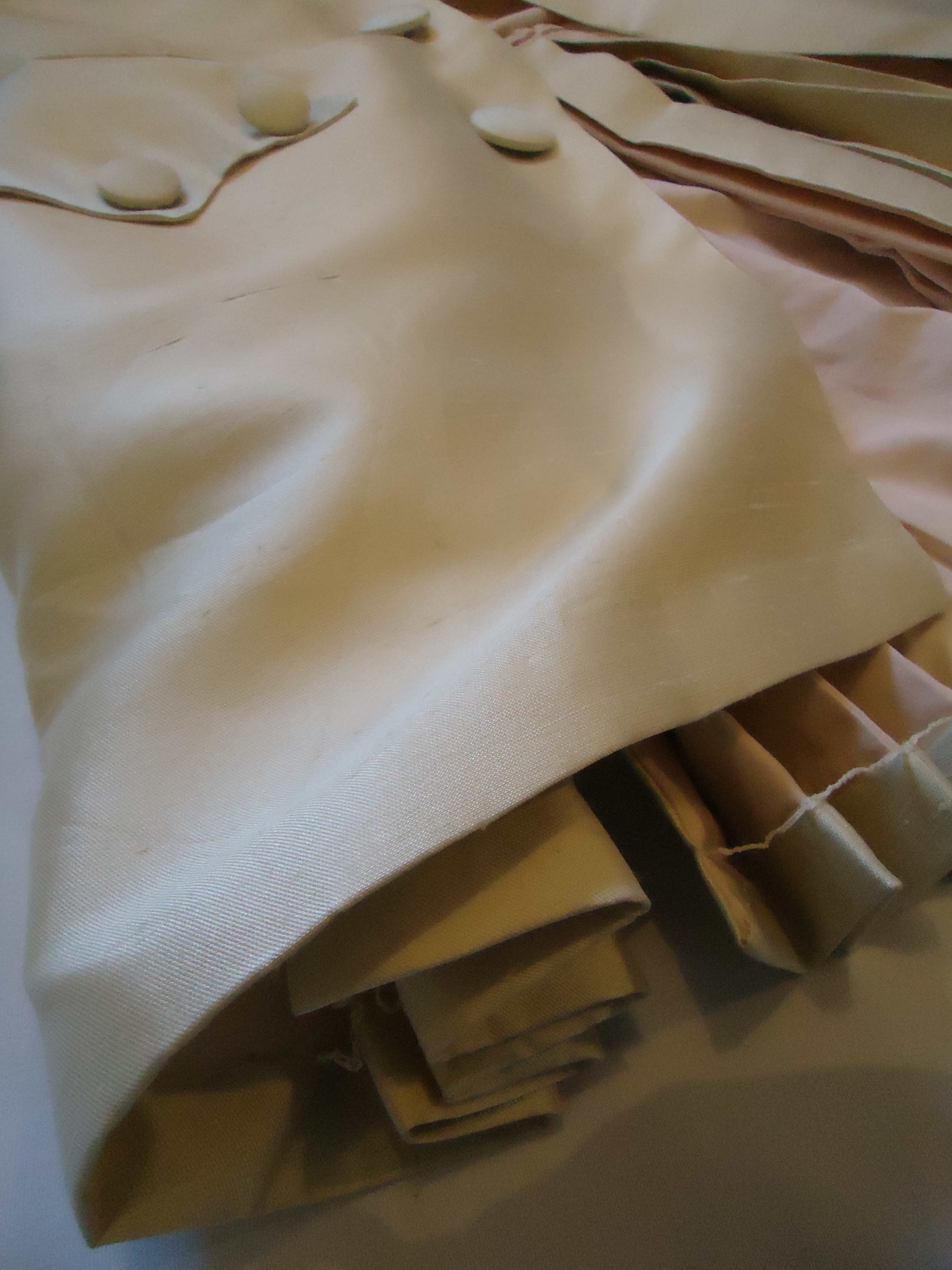
- The Coat was also to have fully lined and fully functional coat pleats, both at the CB seam (pleats on either side) and the Side Back Seam (again with pleats either side of this seam). This amounted to 3 sets of pleats with 2 groups of pleats to each 
set. Each group of pleats had 4 pleats with the final pleat turning back towards Ivory silk Dupion 18th Cent Breeches - HandBound Costumes, bespoke breeches, handmade tailored outfits,custom made historical garmentsthe inside of the coat. As the coat was fully lined so then were these pleats and they hung beautifully. As is necessary with such pleats, a chain stitch was formed to control the pleats. This thread join was only visible from the inside.

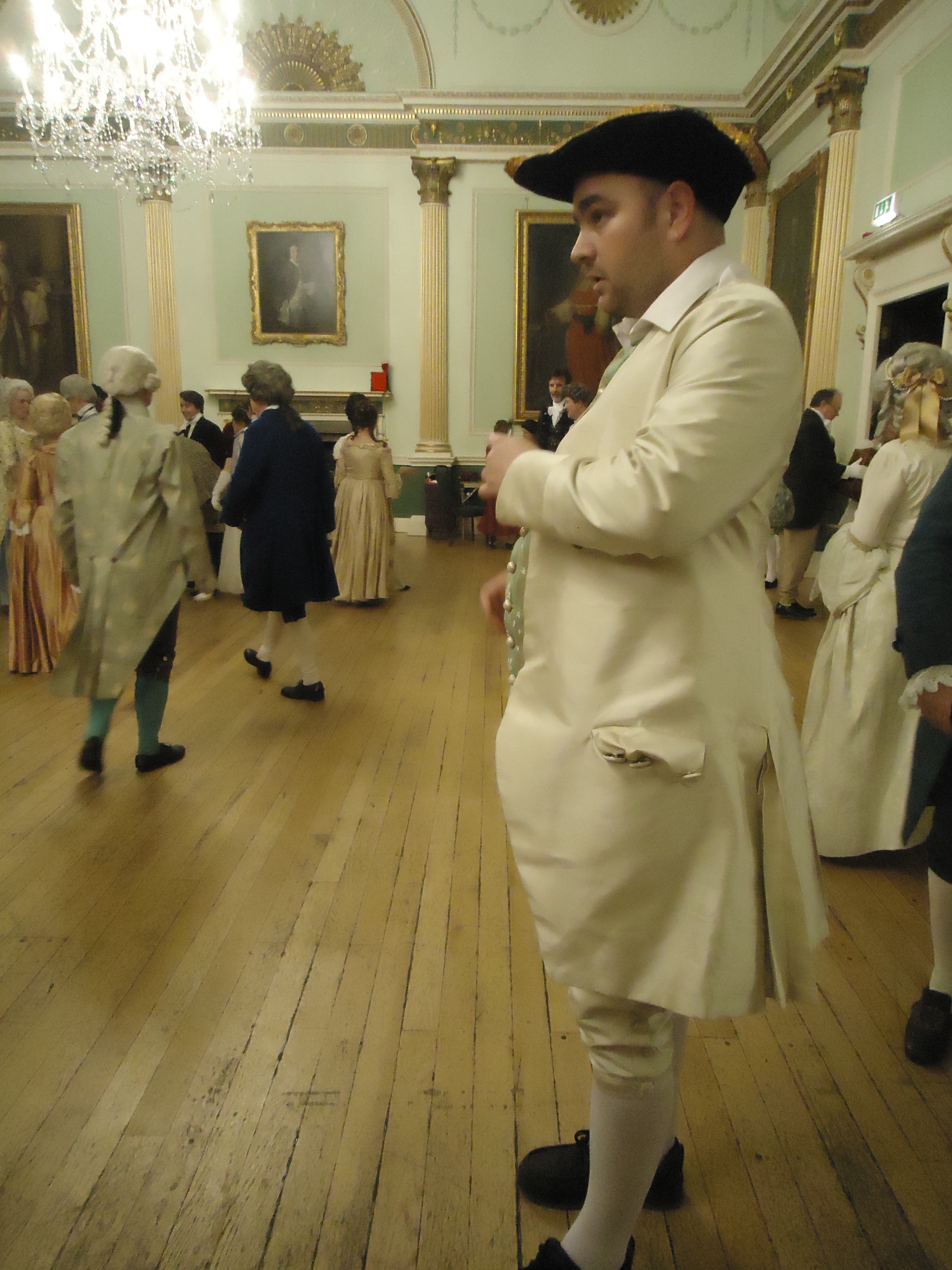
Here are some photos from the actual event:

The Grand Georgian Ball!

Coat and breeches and Waistcoat made by HandBound Costumes, Bespoke Eighteenth Century Costumes, hand made Historical Costumes and Clothing, 18th century made to measure costumes clothing and garments, Custom made handmade bespoke made to measure split fall breeches in dupion silk, re-enactment eighteenth century clothing, mid 1700's Georgian collarless coat with plains cuffs and decorative button stands, long waistcoat with many buttons, coat with deep pockets and shaped pocket flap and covered buttons
 And another...
hand made eighteenth century mens costume by HandBound Costumes, replica made historical costumes, bespoke men's tailoring and historical garments, jacket waistocat and breeches; the 3 piece suit from the 1700's
And another...hand made eighteenth century mens costume by HandBound Costumes, replica made historical costumes, bespoke men's tailoring and historical garments, jacket waistocat and breeches; the 3 piece suit from the 1700's


Thursday, 20 March 2014

The Stomacher-Styled Stays Problem

Robe a l'Anglais - 1748 - HandBound Costumes - Stays research, how stays were worn, Stomacher styled stays, robe a l'anglais and how they were dressed
(UPDATE: Having spoken to a Costume Historian - he doesn't think this dress is genuine. It comes in connection with a film and whereas we thought it was the basis of the film's dress, it now seems as if this is the replica! Which makes our using this dress as an example of what we are talking about here rather redundant - but the problem remains the same so please read on!!!!)

We are a bit bemused!
Today, we sat down with the sole purpose to start the research and sampling process for the Robe a l'Anglais that will match the Philadelphia Stays and we have suddenly hit a rather surprising wall.
Our general understanding was that Stays kind of fell into 3 categories:
- Fully Functional Stays - that were worn above the shift and under all other garments and designed to create the shape  ONLY and not be seen.
- Stomacher Styled Stays - that had decorative fronts and were worn above the shift and jutted out over the petticoat with the CF point. That were also functioning stays and fully boned. Could be covered, decorated with ribbons, fabric or furbellows.
- Training Stays and Jumps.Philadephia Stays with Waistline drawn in - HandBound Costumes Research - Stomacher Styled Stays - Decorative Stays - How were Decorative Stays worn? - Were Stays seen?
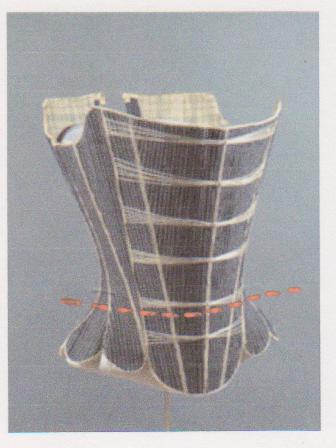
This is the problem that we are facing. As you can see from the above image the waist line is a good 3 1/2" to 4" above the Silver Tissue Dress-Bath Fash Mus - HandBound Costume, Eighteenth Century Costume Research, Stomachers and Stays: how they were worn, How do you wear Stays designed to be seen?, Decorated Stays - how were they worn, Corsets, Stays, jumps, Eighteenth century undergarments, Order of Dressing in Georgian costumefirst tab indent. Now, we know that we have cut out our version of these stays a little low compared to this pair - on our next sample the whole bottom hem will be brought up by about 1 1/2", but even with this alteration we would still be facing the same problem. The hip-pads and petticoat would have to be tied on way beneath the line of the first white thread decoration bit and would struggle (surely!) with falling off. Plus, the neat high-waisted line so famous in the Robe a l'Anglais and Robe a la Francais dresses would be lowered dramatically if this happened.
On the right here is am image of a dress exhibiting the way that we thought these Stays would work. This is a dress from the previous century entitled 'The Silver Tissue Dress' and can be found in the Bath Fashion Museum.
As you can see from the image that the Centre Front (CF) point sits out over the petticoat while the rest gets tucked in inside the waistband. There are Stays out there that do work like this - the evidence of it being the height of the first tab and how it almost sits at the waistline, but there are also some Stays out there that just clearly don't.
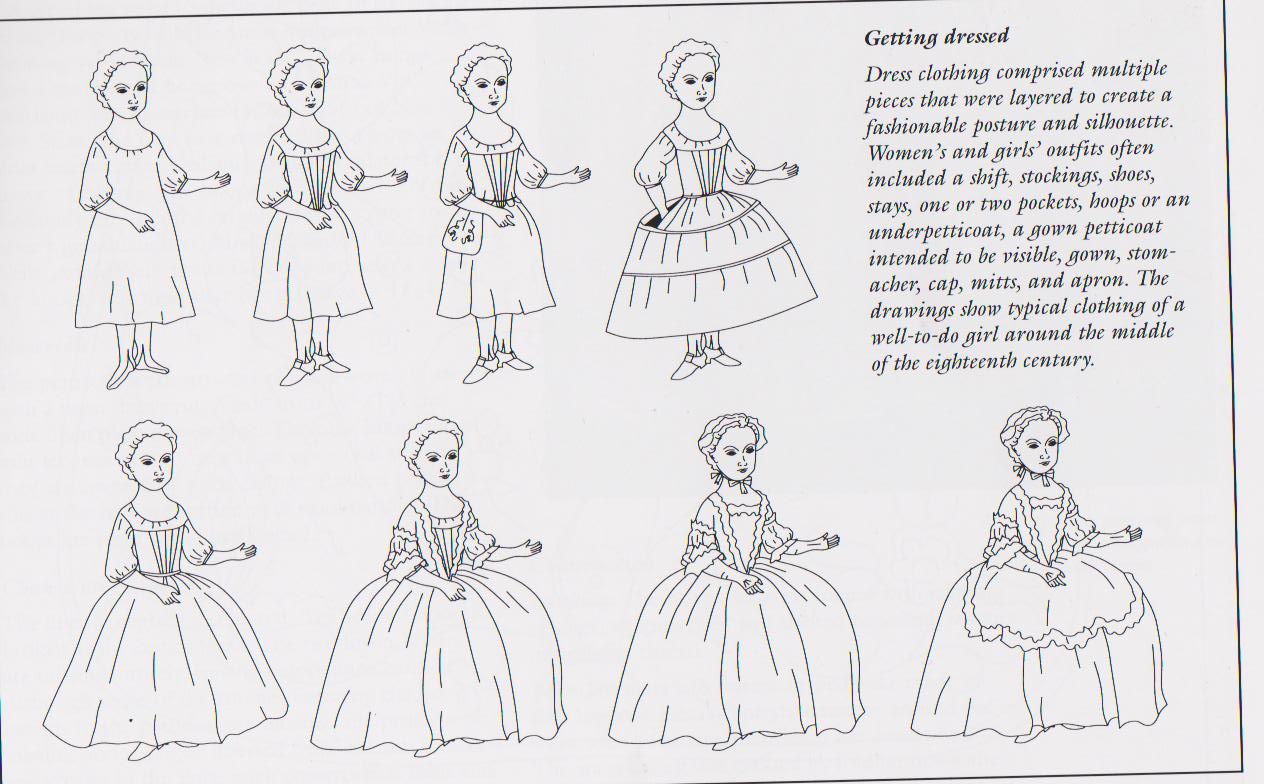
Here is an image of the order of dressing as given by Linda Baumgarten and John Watson.
scanned in order of dress, dressing order of the eighteenth century, georgian costume, 18th cent costume research, how to dress in 1700's, re-enactment information
Order Featured in Image Above:
- Shift on first.
- Then the stays.
- Next the pockets are tied on.
- Then the Hooped Petticoat is tied on over the top of the Stays
- Then the Dresses Petticoat is tied on
- And then finally the dress is placed on.
IF we used this above dressing order for dressing our Philadephia Stays then there would be no visible point seen of the Stays as it would be hidden under the Petticoat and the Hooped Petticoat and there wouldn't be a flat and reliable surface  either as each of the afore-mentioned petticoats have gathers and fullness that would bulk out the waistline.
Lets see if we can explain what we mean...
Here's a close-up of the detail of the Silver Tissue Dress:
Silver Tissue Dress-Bath Fash Mus - HandBound Costume, Eighteenth Century Costume Research, Stomachers and Stays: how they were worn, How do you wear Stays designed to be seen?, Decorated Stays - how were they worn, Corsets, Stays, jumps, Eighteenth century undergarments, Order of Dressing in Georgian costume
As you can see the Centre Front (CF) point clearly juts out over the petticoat whereas the rest of the tabs all sit under the petticoat at the sides and back. This is how we envisioned ours working but if you look at the image of the Philadelphia Stays at the start of this Post,  for the petticoat to act like this image here, it would have to sit well below the waist line.
Each tie-on item would create the same problem: either interrupt the decorated front or get lowered to well below the waistline.
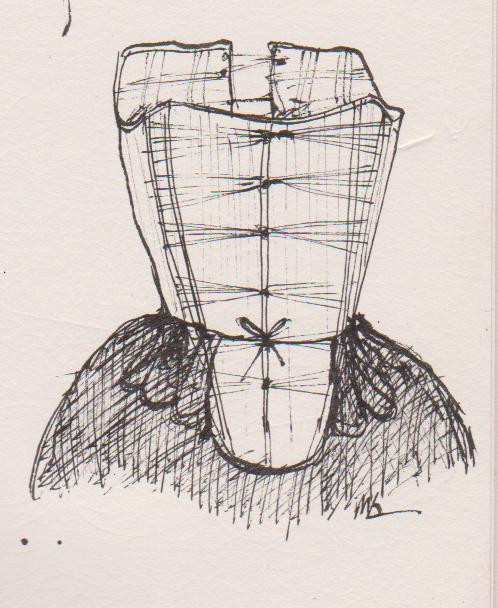
- We've done a quick sketch to try and show the other variations of problems. (super-quick sketches!)
- First is the a drawing of what the Hip pads would look like tied on.
HandBound Costume, Eighteenth Century Costume Research, Stomachers and Stays: how they were worn, How do you wear Stays designed to be seen?, Decorated Stays - how were they worn, Corsets, Stays, jumps, Eighteenth century undergarments, Order of Dressing in Georgian costume
- There are about 4 things that we can think of that get tied on in the dressing process. These are as follows:
- The Hip Pads or Hoops
- The Pockets
- The Petticoat
- The dress.
Even the dresses had a tie that was sewn at the CB of the lining and tied round over the stays and under the stomacher. This 'tying' it on helped hold the back of the dress tight against the corset and played a part in creating that beautifully flat and neat back that the Robe a l'Anglais present so perfectly.
Dress c.1750-90 Bath Fashion Museum, Handbound Costumes research and Images, Eighteenth Century historical Costumes, Robe a l'anglais, Georgian Dress, Duchess Clothing, 1700's Costumes, 18th Century Clothing, what people wore
Photo taken During a Study Session. Image Courtesy of the Fashion Museum, Bath and N.E Somerset Council
Next, having thought about this issue we used a skirt from the Bath Fashion Musuem to open our minds to the idea of having the petticoat have a CF opening to sit under our lowered CF point but then stretch the rest up to the waistline and sit where it should be. We thought we'd got it but again the same problem...there is another set of ties still in the way.
HandBound Costume, Eighteenth Century Costume Research, Stomachers and Stays: how they were worn, How do you wear Stays designed to be seen?, Decorated Stays - how were they worn, Corsets, Stays, jumps, Eighteenth century undergarments, Order of Dressing in Georgian costume - As you can see from both these images that this way of cutting the petticoat would work and does seem to have been done before.
- We emailed a couple of museums about this problem in our search and the Manchester Art Galleries got back to us saying they had found the same problem with their Red Stays from the previous century. We found this mightily encouraging.
- It also raises another interesting problem we've not really seen before. Most of the Stomachers in the museums tend to be fairly flimsy, a few have bones in but certainly not enough bones to create a centre flat front. So then, how did they not buckle and bump over the  ties and the bulk of the petticoats being tied on? Just another interesting ponder. If you look at the very first image of this Post it makes you wonder that if that centre piece is a Stomacher and not part of a matching pair of Stays then was it a) unlike any other Stomacher we've ever seen and stiffened with paste and boned and curved or b) stretched tort and tight over the Stays beneath it. In which case this Stays would have had to be pretty much the same shape as the Stomacher and again going over the petticoat to create such a uniformed and smooth look. Have a look at it now and just think of the logistics of how it was done. What we need to do is find out which Museum this dress is from and actually ask  them how it works. We personally thinks it's a pair of Stays as if you look at the bottom of the centre piece you can see this fine binding and it also curves at that CF point in the exact same way that Stays curved at this time, in the 40's.
- Our main point of interest is, is not so much finding a way round it - rather knowing how they actually did it - how did they actually dress themselves - what examples of this do we have in our museums, what recollections do we have in their letters. We know it's endless to say 'this needs more research' but it simply does. One day we find an excerpt in a letter mentioning this exact thing. But until that day we shall just have to use our brains and find our own solution.

Tuesday, 11 February 2014

The Arletan Sample.

Arletan Sample:

I've been working on copying a pair of stays from the Arletan Museum in France, dated 1750-60. It's a pair we've found
online in our research for HandBound Costumes and we are hoping it will appear in our collection soon.
As part of our product development process we make up the garment several times testing out the pattern until we get it's shape, fit and pattern just right. So we thought we'd post up our progress.
This is just the first sample and purely for interest, we've put up a photo of our original patttern and the adaptations we've made since working on the sample.
Here, to the right, is the original corset from the Arletan Museum - isn't it beautiful! It has that very bulky busk shape at
the CF which becomes more dominant as it goes into the bottom point. It has a wonderful shape to the decolletage and although you can't see them so well in this image, it has little side pads for the hips of the skirt. Also, what's interesting is that the straps don't appear to be attached to the CF panel. If you look very closely they actually sit behind it, which is most curious. This is a fully boned pair of stays but has been covered with the decorative floral linen layer. the tabs at the side are of, we assume, the under layer and we have tried to emulate this look in our samples.
It's also a fairly high-waisted pair of stays, the top of the tabs nearly sitting on the waistline and this could be for a few reasons. The lady it was made for was a short person or that it was for a young lady just coming out of childhood, or quite simply, it could be the beginning of the tide when the waistline did start to rise at the end of the century. 1760 is a little early for this but it's not impossible. The other reason why it might be quite high-waisted is that this could be a local fashionable shape particular for Arletan. This is not hugely unlikely, as from several paintings done by Antoine Raspal (and that also feature highly in the museum) show that there was a specific regional style to the area. But either way - it's a beautiful pair of stays.
Now, what is most important to each garment we try and replica, is not always the fabric. Getting the fabric correct just makes it more recognisable for the customer but there still a lot to replicating a garment that is more than the fabric. As you can see from these two images there is a shape and a style here which must be in the eye  when the finish garment has been made.
This kind of details for these Stays are:
- Long, broad and curved CF point.
- Long and High back, going straight into the straps.
- Scye (Armhole) and Bustline create a shape in themselves.
- 4 panels either side.
- Covered.
- White tabs uncovered. (long and getting shorter towards front)
- Hip roll on the side (not yet included in our sampling)
- There's also a specific shape about the front bust line that must be got right.
- It's not been totally decided yet if we're gong to replicate the heavy triangle busk look that curves the CF point so heavily - this is not a popular style to re-enact as it is rather unflattering. We might just replicate it without it and go in for a narrower CF point.
You'll probably be able to see straight away how ours needs working on!
Please see here:


Our Alterations:
- Bring in the curve of the neckline by about an inch.
- Slim down the CF point - we also need to perfect getting this sewn up in a smoother way.
- If we narrow the top width of the CF Point and bring in the sweeping Side Panel, we are hoping it might give our sample a bit more of a slimmer look.
- The CB needs to come down a little lower - by about 1/2 and inch and take away some of the angle as it rises up too meet the tabs = make this angle less so.
- Infact the whole CF panel needs to be made slimmer - adding to the narrower shape to the front - our cutting has made it look much broader than it is.
- Side front tabs need lowering and the angle of the Side panel section that goes into a point needs being made more severe.
- The height of the CB needs lowering a little - it sits a little high on the neck. Also, changing the angle slightly of the strap base.
- We didn't need to eyelet that far down the back either, we accidentally got a bit carried away.
- Scye needs re-drawing - it needs that sweeping look that carries on into the bust line.
All these alterations look like they've been met when we look at out original pattern but that's the secret about pattern cutting - always sample until you get it right!

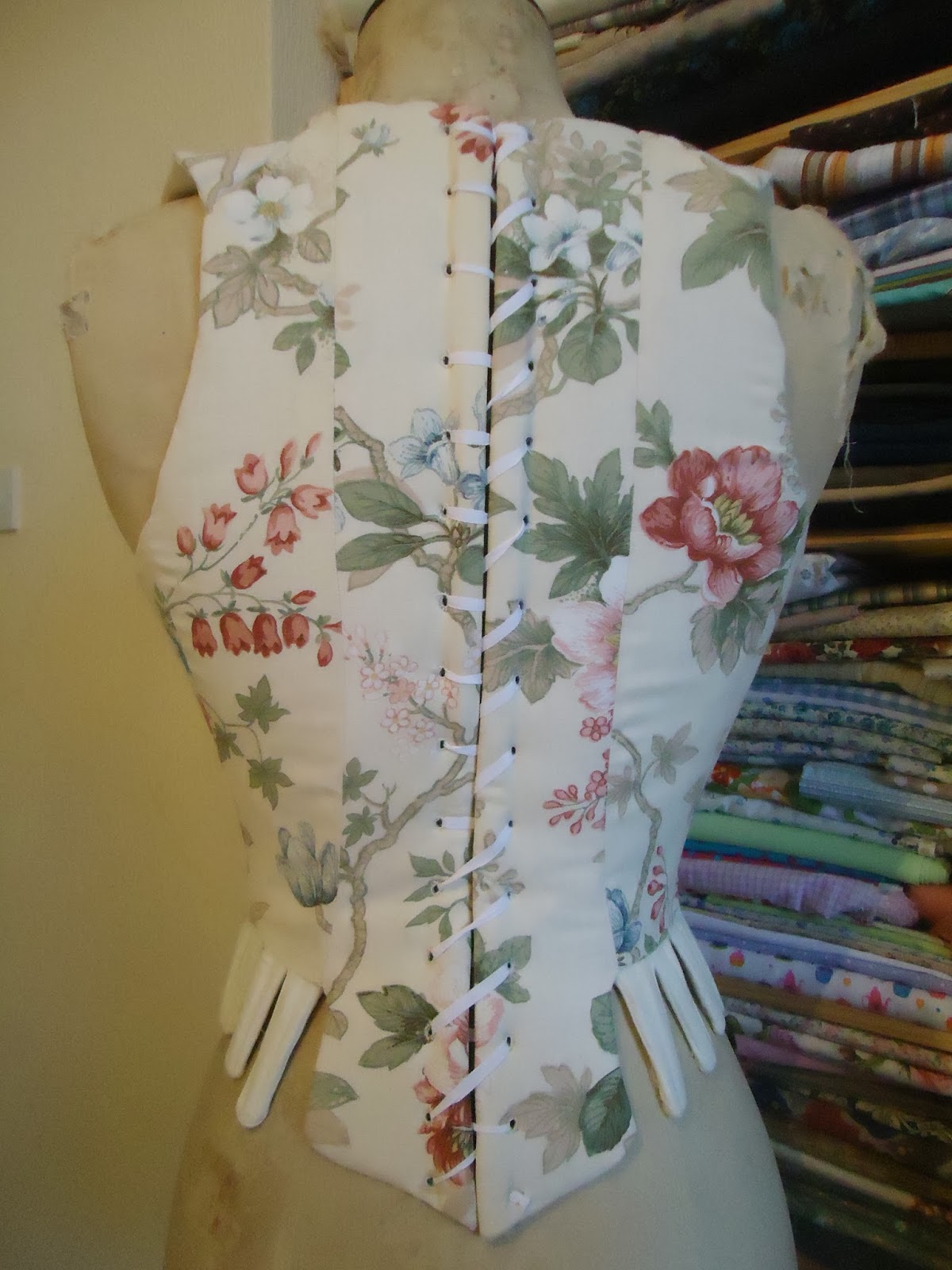
Our First Sample Pattern:


And now here's our alterations: