Saturday, 4 July 2015

How the Handkerchief or Neck Cloth was Worn

The Neck Cloth

We thought we'd have a page designated to the various ways in which Neck Cloths (oh that ambiguous term) could be worn. All of these methods have been taken direct from the paintings, portraits and etchings that fill our research. We've also created a page trying to plot when these Methods of wearing the Neck Cloth filtered in and out of fashion - we do say 'Try'!
8 General Techniques:
Having studied the images we think we've pinned it down to being worn in 8 different ways.
- The Tucked Method:
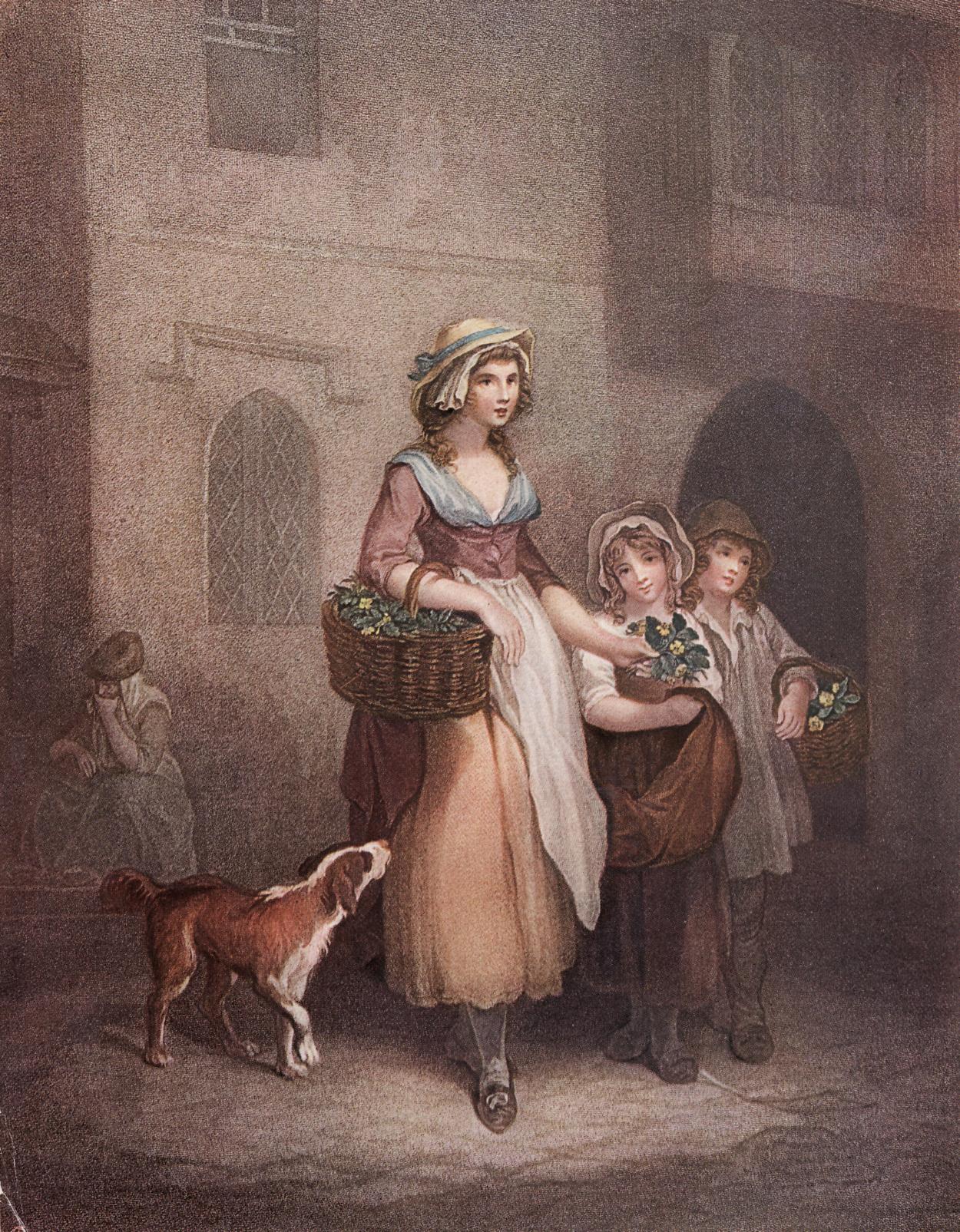
The Primrose seller - wheatley - 1793, A study on how neck cloths or Fichus or handkerchiefs were worn in the 18th century, historical costume research - a look into georgian costume and how it was worn., historical replica costume, Hand made period clothing, reenactment csotume, bespoke garments form the 18th century, accessories of the 18th century, dress like a georgian
Wheatley - 1793
Use your imagination and you will probably get there faster than we can type - but essentially the ends of the Handkerchief (Cunningtons) gets tucked into the neck line of the dress and you don't see them again. The rest can then get flumped up and draped nicely or flattened depending on the year. This cloths main fashion years was in the late 18th c - somewhere between 1780 and 1790 when the dresses were CF meeting which made this an obvious choice but it was also worn fairly faithfully before that.

- Through The Lacing Method:
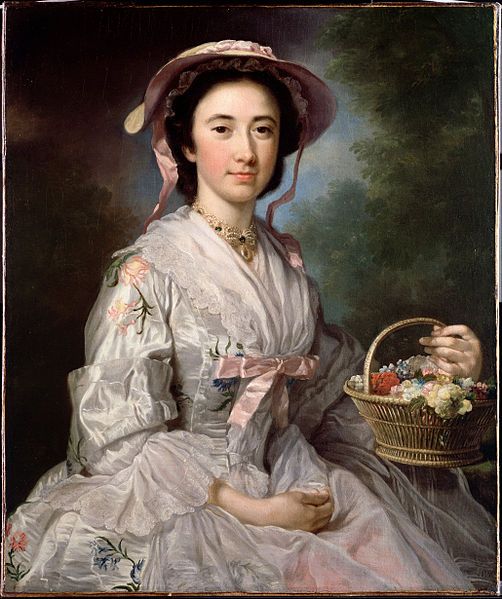
A study on how neck cloths or Fichus or handkerchiefs were worn in the 18th century, historical costume research - a look into georgian costume and how it was worn., historical replica costume, Hand made period clothing, reenactment csotume, bespoke garments form the 18th century, accessories of the 18th century, dress like a georgian
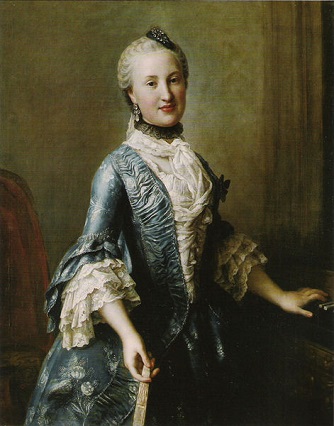
c.1750 - Knapton
Probably the most used technique in the whole century - the method behind this was simply draping the folded or single layer Neck Cloth over the shoulders, as with the above style, but instead of just shoving the ends into the dress, they get delicately (or clumsily!) pulled through under the central lacing if the dress has it, or Echelle Ribbons, underneath the 'Buckle for the Stays' or ties that the dress has. It's interesting to see in the paintings that generally (and we say 'generally' with held breath) that if the dress has a plain stomacher with nothing connecting the two Robings then the 'Tucked In' method was used while if it had something connecting the two Robings then this method was used. Which is why we have said 'probably the most used' as this form of dress was one of the longer lasting designs for the 18th c.
The Crossed Over Method:
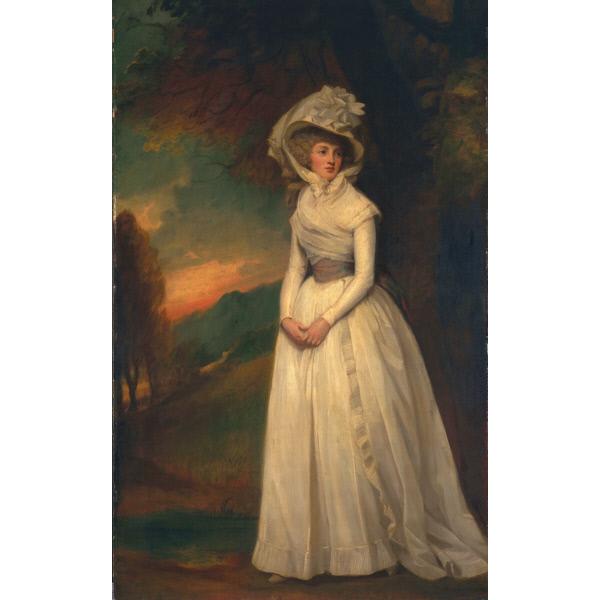
A study on how neck cloths or Fichus or handkerchiefs were worn in the 18th century, historical costume research - a look into georgian costume and how it was worn., historical replica costume, Hand made period clothing, reenactment csotume, bespoke garments form the 18th century, accessories of the 18th century, dress like a georgian
Romney - 1791
Only sporadically seen in the paintings, this may well be because it was a bit more a working woman's way of wearing her neck cloth - it's hard to tell. But the ends are pulled across the bust and tied at the back creating a cross over effect. This Method however, really comes into it's own in the 80s and 90s when the gowns no longer have a central stomacher but meet at the CF. This Cross effect was obviously a fashionable style as it can be found in Dress form, in the neck cloth form and in Stay form - suddenly becoming a feature on the Stays with cross over straps that hooked or tied at the front. Even the Zone dress is a kind of nod towards this Cross-Over shape and was obviously pleasing to the fashionable eye.
The Loose Method:
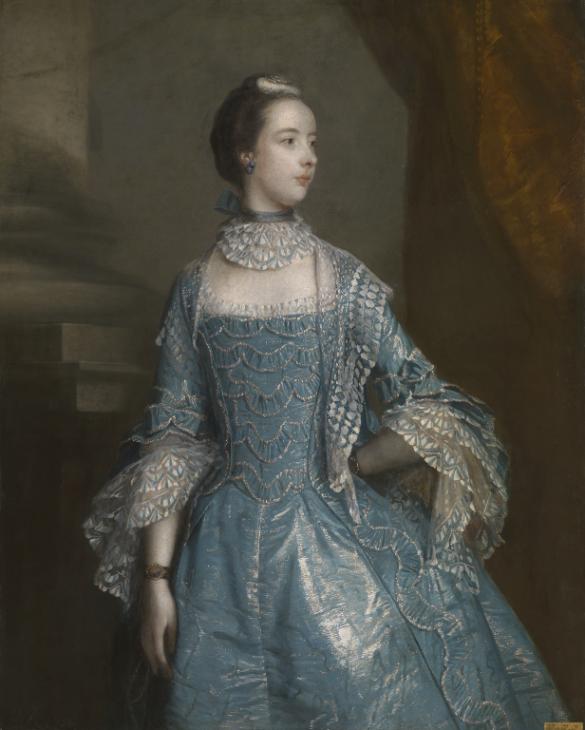
Suzanna Beckford 1756 Sir Joshua Reynolds 1723-1792 , fashion in the 18th century, lace trim examples in the 1700's, handbound hand made costume research, museum based costume research, necklace in the georgian period, bepsoke made to measure historical gowns by HandBound Costumes, bespoke costumiery, period costume maker, reenactment costume
Reynolds - 1756
We tend to think of this way of wearing a neck cloth as being much more Victorian but it does seem to crop up every now and then in 18th century art. Literally as it's described the neck cloth is draped over the shoulders in the usual manner and then the ends are just left to dangle freely. If this method turns up in a working class sketch it's hard to tell if it's worn like this because it has come loose but it's seen in enough distinct ways to earn it's own class. Again, this could be worn for most decades in the 18thc but had it's high point of fashion in the 50's to 60's when the fashion for super sheer cloths came in and this method allowed them to be seen to their greatest effect and also no longer hid the dress so much due to their see-through nature. This method was also worn with the black neck cloths of the 60s.

The Tied Method:
A study on how neck cloths or Fichus or handkerchiefs were worn in the 18th century, historical costume research - a look into georgian costume and how it was worn., historical replica costume, Hand made period clothing, reenactment csotume, bespoke garments form the 18th century, accessories of the 18th century, dress like a georgian
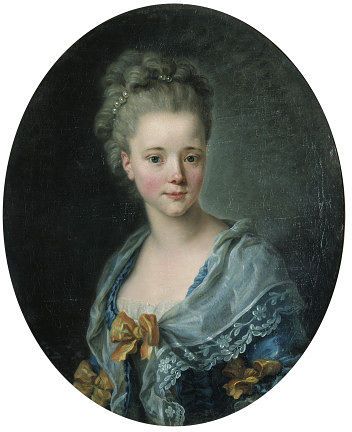
c.1755 - Rotari
Again, not hard to imagine really but the Neck cloth is looped over itself in a half knot manner, like you would a lazy cravat - just draped over and left to hang loose. It could also be slightly tucked in or also, treated to the full 'Through the Lacing Method'. This isn't a style appears to have massively took off in Britain but it can be seen enough to warrant it's entry.

  - The Shoulder Method:
A study on how neck cloths or Fichus or handkerchiefs were worn in the 18th century, historical costume research - a look into georgian costume and how it was worn., historical replica costume, Hand made period clothing, reenactment csotume, bespoke garments form the 18th century, accessories of the 18th century, dress like a georgian
No details - c.1770
Treated like a shawl this method's techniques of wearing were to be draped and pulled around the shoulders and then seemingly held by something at the CF so that the ends then more shortly drape and fall down the Centre of the Stomacher or CF of the gown. Along with the Loose Method, this technique was popular during the 50s with their sheer cloths, the 60s with the black cloths and also spreading out into the 70s and 80s.
- The Twist Method:
Not normally seen in British fashion except with l'enseigne de garsaint by watteau, HandBound historical costume research, what the early georgians wore, images of early 1700s fashionFurbelows or Lace, we've included this Method just because it did exist and there's no reason why it couldnt've been worn in fashionable wear but going unrecorded in the paintings. It seemed to be primarily a French Fashion - especially when the item being twisted was a neck cloth - but as France was where our fashions flowing in from at this time there's no reason to assume no ladies wore it as such. We have no record of neck cloths being worn in this way within British paintings. Similar to the Tied Method, the Neck Cloth got twisted into a constant spiral falling down the CF of the gown. The habit of wearing Furbellow/Lace/Chenille in the Twist Method seems mainly to concentrate in the years 20s-30s and then 70s and 80s. in the latter decades it seemed to blend well with the mass amounts of crazy trim that could adorn the Court Wear for these years.
And Finally....
- The Pinned Method:
A study on how neck cloths or Fichus or handkerchiefs were worn in the 18th century, historical costume research - a look into georgian costume and how it was worn., historical replica costume, Hand made period clothing, reenactment csotume, bespoke garments form the 18th century, accessories of the 18th century, dress like a georgianThis is a bit of a mixed bag Method as it tends to house some of the images that don't quite come into any of the other categories because of the way they are held onto the body - they can surely only be pinned. We don't have many of these images but those that we've squirreled out we hope you can see the difference between this Method and the others.
We've also written a piece about the progress of fashion this garment has through the 18th century so if you would like to read more then please click here: The Neck Cloth!

Thursday, 2 July 2015

Watteau's 'L'enseigne de garsaint'

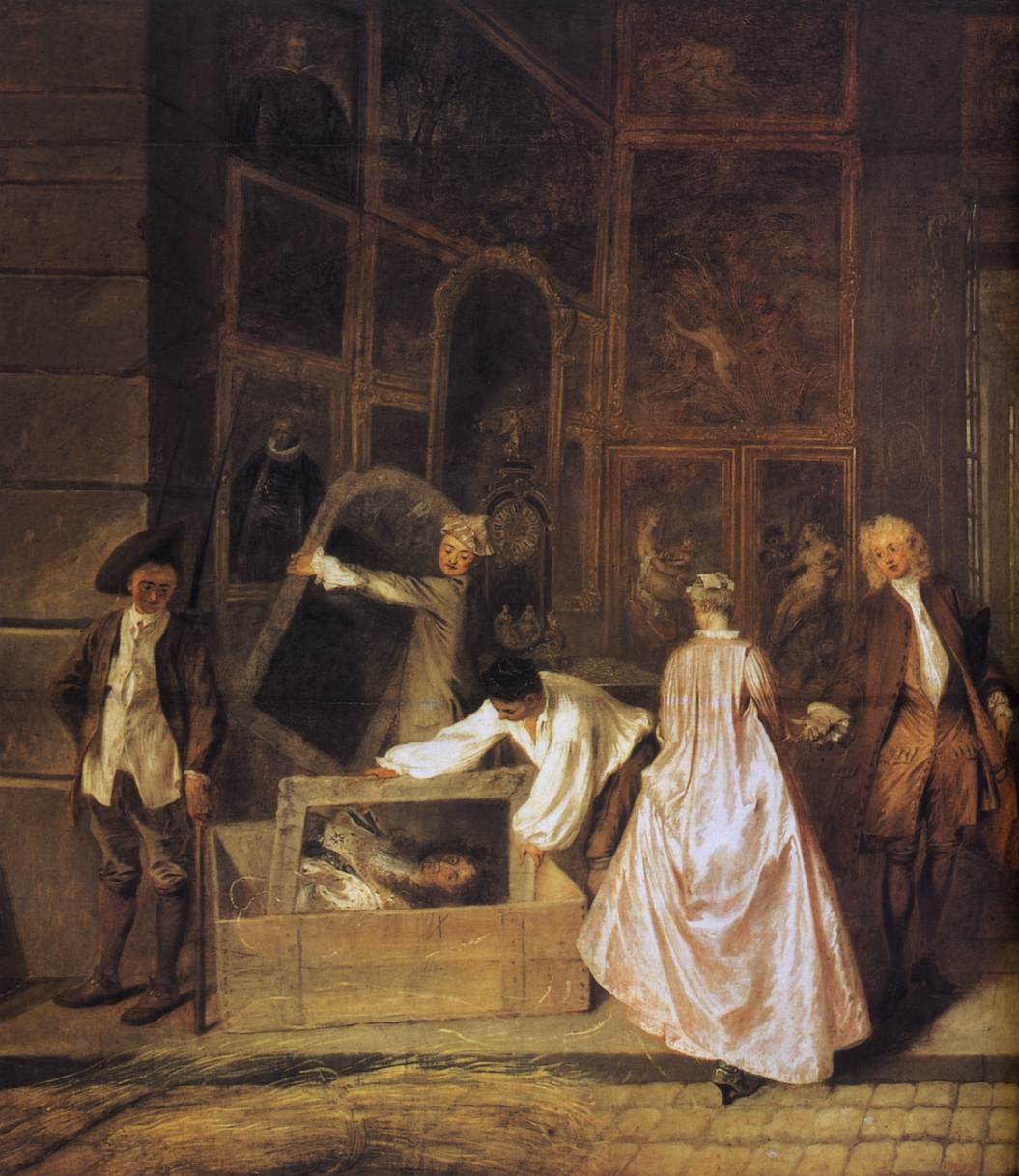
L'enseigne de Garsaint:

We've used this painting a few times - a) as an example of the almost Victorian shape of the sweeping round hoop or Bell Hoop and the round full skirts it was making fashionable but also for the details in the man's coat, the loose sack with it's weird sleeve and the man's shirt. So much out of one painting!
This is not a long and detailed page - we just wanted to be able to put this image up somewhere and as our knowledge of this early period of the 18th century grows then we can add to the details that we see here.


The Painting:
l'enseigne de garsaint by watteau, HandBound historical costume research, what the early georgians wore
What an amazing painting! According to good 'Ol Wikipedia; it wasn't just painted in 1720 but on the very first day of that year - 1st January 1720. we'll put up some of the details in a bit but here you can see the early Sacks and how their pleats were incredibly loose and unset. You can see the round shape of fashion for the Bell hoop with the lady leaning at the counter and the lady in dark brown at the back looks to be in a Mantua. But, we'll go into more details in a bit. We just wanted to put it up as a whole painting before we start.
Watteau -l'enseigne de garsaint -  1720 - HandBound

Details:
Lady in Pink:
- She is wearing an early from of the Sack Back gown - rightly called a Robe a la Francais as it originates in France.
- She wears it with a matching pettcoat - see the hem of her garment where you get a glimpse of her shoe!
- She wears a small Lappet cap with her Lappets piled up on the top.
- She wears no Neck Cloth but just a neat rim of about 1 1/2- 1 3/4" wide frill from her shift or a tucker.
- The sack back part of the gown appears to be a separate outer robe as it doesn't appear to have sleeves but a large arm hole where a possible undergown comes through with the sleeves ?????
- Is it snobby to say she is not wearing matching shoes!
Man Proffering a Hand:
- He wears a classic mans outfit for the period - various shades of brown and with the longer coat, the long and skirted waist coat and the fashionably small glimpse of the breeches.
- He also has his stockings rolled up over his breeches which is very fashionable for this part of the century.
- He wears a curly full wig - don't ask us the name for it - we are useless with wigs!
- His shirt has a ruffled front.
- He also is wearing his waistcoat opened and only done up at the waist by a few buttons. This style was in fashion it appears for quite a while with many paintings going on into the 50's with men dressing their waistcoats in this manner.
The 3 Other Men:
- The one by the wall wears a Tricorne! Has a more working man's type of waistcoat - it being un-skirted and flat at the hem and also shorter. he too wears his partially done up but with a few more buttons fastened. Breeches look fairly baggy but this ties in with the fashion - he has dark stockings but so does the first man apparantly. he has a cane and also his coat is plainer and shorter.
- The man taking out the painting is in a full and voluminous sleeved shirt and breeches - no ruffles at the neck.
- man holding the Mirror looks to have a functioning cuff opening of a fairly neat looking sleeve and fuller looking coat. He appears to be wearing a turkish style of head-wear but we may have that wrong.
l'enseigne de garsaint by watteau, HandBound historical costume research, what the early georgians wore, images of early 1700s fashion
The Kneeling Man:
- What beautiful and neat looking shoes he has - I know we only get to see the underside but in that sense you really get to see the shape of the shoe.
- he has a full skirted jacket with atleast 2 vents with pleats either side and CB vent that is flat - interesting! There is a button on the top of each side vent and a broad-ish placket on either side of the CB vent.
- His coat has pockets and has buttons running down the whole length of the CF opening. It also looks fairly neat in cut and his sleevs not too baggy but that end in a broad type of Wing Cuff with rounded ends.
- He carries a Tricorne hat under his arm.
- Wears Ruffles at his sleeve.
- His wig is similar to other main man but with more detail of how the back separates into two pig tail-type curls.
l'enseigne de garsaint by watteau, HandBound historical costume research, what the early georgians wore, images of early 1700s fashion
Seated Lady in Pink Stripe:
- Unusual bodice style of dress - this definitely needs more research as it's details are kind of lost on us right this minute. It almost looks like she has the two robings but then something strange happens at the waist.
- Her shift sits high up above her dress and is flat - similar to others we've seen in this period.
- She's wearing long pale coloured gloves and what looks like almost crimped ruffles which are very full but not overly deep in length.
- She has a twist of something at her neck - there are quite a few images of this kind of neck wear - often in lace or in a blue twist of what loks like Chenille trim.
- She wears a long black cloak.
l'enseigne de garsaint by watteau, HandBound historical costume research, what the early georgians wore, images of early 1700s fashion
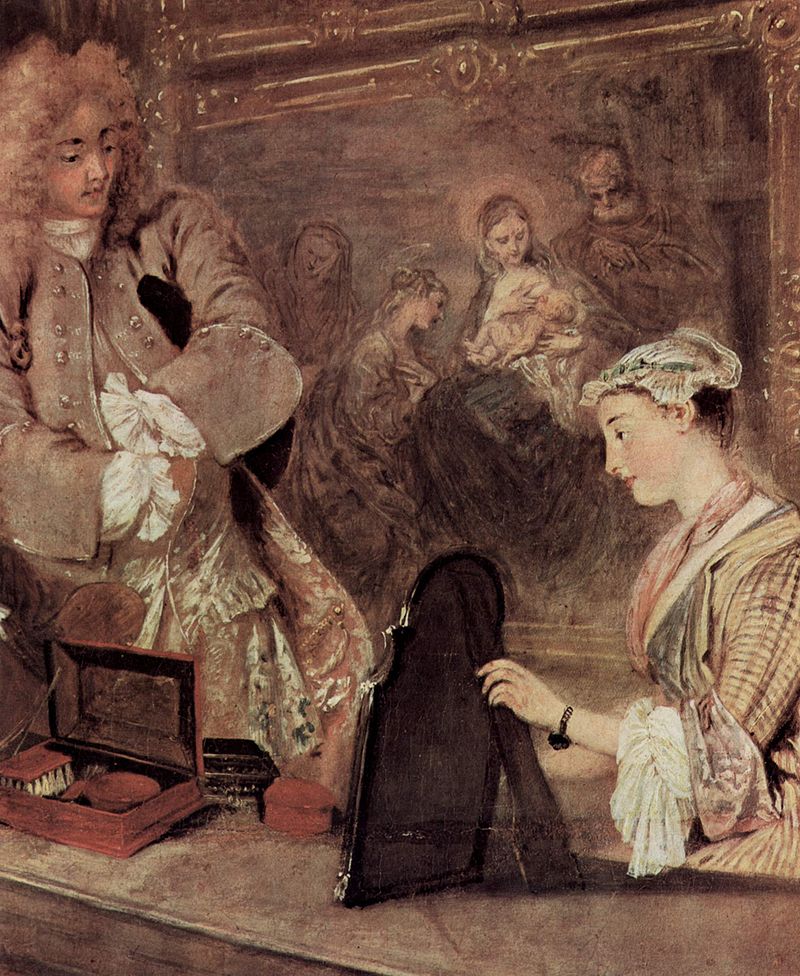
Lady Behind the Counter:
- She wears what seems to be a similar dress as the other lady - same loose but broad sweeping fronts - it seems to have loose Robings to the gown.
- It's a striped cloth with something different at the front. She wears a cap which we didn't think came into fashion until the 1760s but here it is as bold as brass so perhaps we're wrong. It's a very light and crimped looking frilled cap with a ribbon and the back pinned up.
- She also wears a similar neck cloth - red/pink and more loosely twisted than the lady lounging opposite her. She wears a black something at her wrist.
- Her cuffs to the gown are loose in cut but pleated at the front. It is a Turn-back cuff and not a Wing Cuff as it is a complete circle and not like the man's cuff who is kneeling on the floor, deeply intently looking at a painting.
- She wears her ruffles from her shift a little below her sleeve, gathered but not overly deep in length.
Man Standing Above her:
- He is fabulously dressed! He wears a grey coat with double buttons and button holes making their way down his CF.
-His coat is collarless and it's sleeves have a kind of Wing Cuff/Boot Cuff finish to them - it must have a specific name but we as yet don't know it! We've seen similar cuffs in the Museum of London but none of Cunnington's descriptions of a Boot Cuff or our knowledge of a Wing Cuff match this exact sleeve ending.
- his Waistcoat is of patterned silk with pockets.
- His shirt is gathered into a plain band at the neck - close fitting to his neck.
- And apart from the cut of his Coat and Waistcoat, you can tell this is still the early 1700s as he has his sword at his side.
- His sleeves end in banded Ruffles and look gorgeous.
 

Tuesday, 9 June 2015

The Daily Mail History Festival

The Daily Mail History

Festival

Daily Mail History Festival Images, HandBound Costumes at Daily Mail History festival, Living History HandBound Costumes, made to measure Historical Costumes, Where can I get a pair of Stays made,
Come and find us - we have a stall in one of the largest all-out History Celebration Festivals in the U.K - And it's a Two Week Countdown!

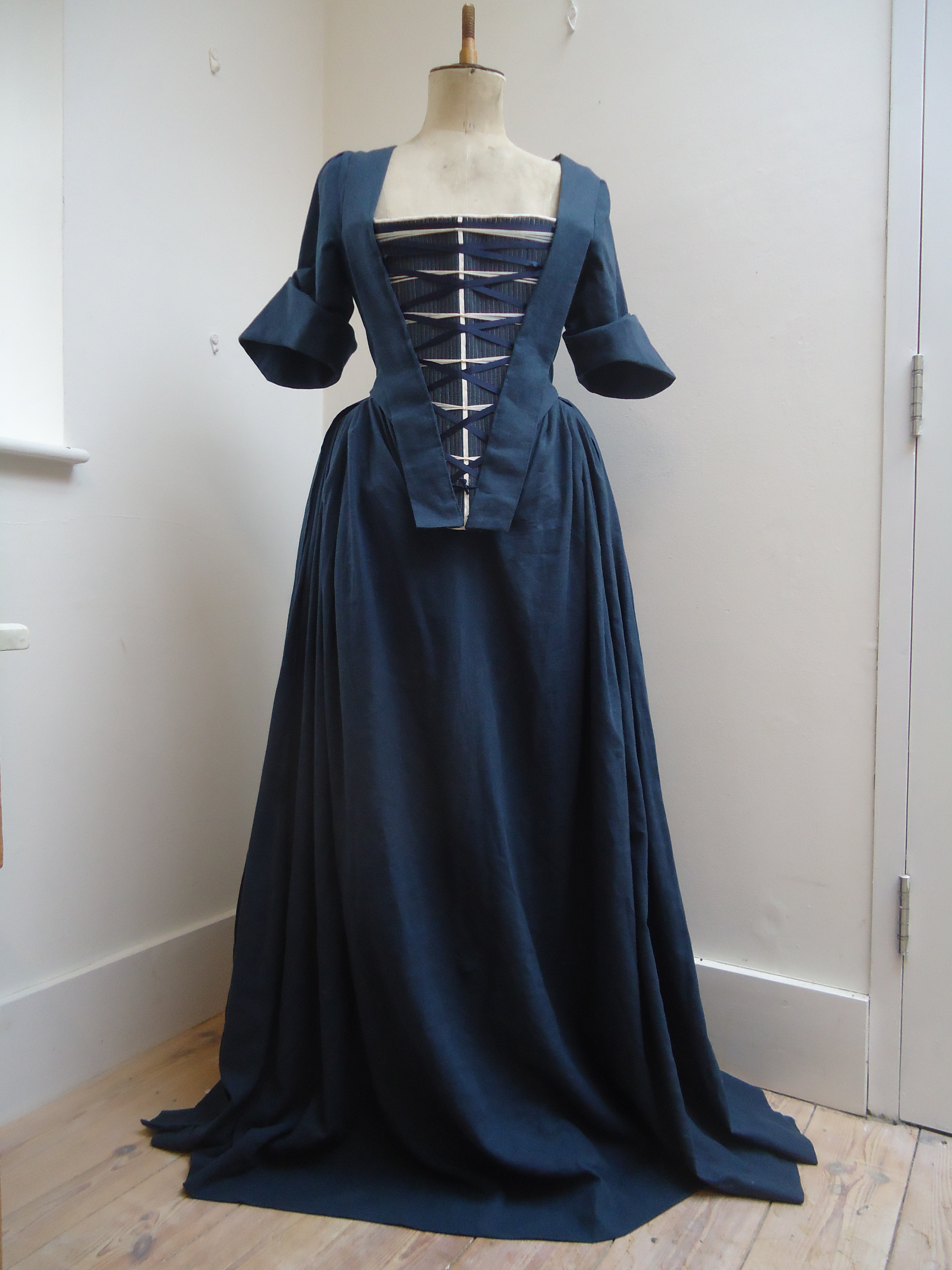
We're going to have on display a new Silk Robe a la FrDaily Mail History Festival Images, HandBound Costumes at Daily Mail History festival, Living History HandBound Costumes, made to measure Historical Costumes, Where can I get a pair of Stays made, ancais which has been based on an original stored at the V&A  - we've taken a mutlitude of notes, photo's, drawings and patterns to be able recreate this stunning dress (apart from the fly trim - fly trim along with Small Pox has disappeared off the planet!!!)
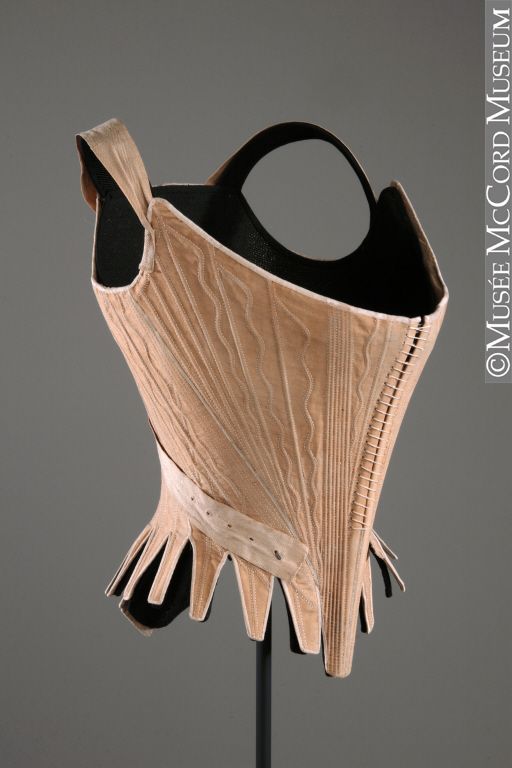
Where can I get a pair of 18th c stays or corset made?, Re-enactment Staymaker, HandBound Historical Costumes specialising in 18th century stays, 18th c corsetry, replica costumes and stays, museum studied clothing including stays and shifts, hand made period costumeWe've also been working on 2 new pairs of Stays which will be having their debut appearance in our collection especially for the market, a short but stunning little Sack with Echelle fronts and a brand new Yellow Robed Anglais based on a Paul Sandby Drawing. We will also be displaying a new Cotton 1780's Anglais based on one of Janet Arnold's dresses along with a Silk/Linen Quilted Petticoat. All of these items we hope will be appearing in our shop probably a stone's throw beyond the market (lets get that out of the way first!) and weWhere can I get a pair of 18th c stays or corset made?, Re-enactment Staymaker, HandBound Historical Costumes specialising in 18th century stays, 18th c corsetry, replica costumes and stays, museum studied clothing including stays and shifts, hand made period costume hope you like them.
Take a look at this amazing festival - there are speakers such as Dan Snow, Antonia Fraser, Ian Hislop (ahh we love this guy), Kate Mosse, The institutional David Starkey, Jon Snow and Neil Oliver to name but a few. Here is a link to the website  http://cvhf.org.uk/about-chalke-valley-history-festival/
Daily Mail History Festival Images, HandBound Costumes at Daily Mail History festival, Living History HandBound Costumes, made to measure Historical Costumes, Where can I get a pair of Stays made,
We'd loReproduction of Linen Chemise from Metropolitan Museum of Art c.1780 by HandBound Historical Costumes, Replica Period Clothing, Linen Undergarments, Georgian Underclothes and underpinnings, 18th century historical costumes made by HandBound Costumes, Metropolitan Museum of Art Chemise from the 1780s replicated by HandBound Costumes, The history of the shirt, what women wore in the 1700s, re-enactment costumes, theatre and film costumier, dress like the duchess, what did marie antionette wear?ve you to come and try a pair of Stays on, flick through our research and man-handle all the costumes you like. We'd be delighted to see you! Exclusively for the markets we attend we have built a range of Stays in virtually every size (and it will just keep on growing!) so that they are able to be tried on and experienced. For the Daily Mail History Festival we hope also to bring in a new 'Shift Corner' with our reproduction Shifts hanging on display for all to see along with their photos of the originals, examples of shifts visible in paintings and a choice of the variations of Linens we have for their making. We also hope to be bringing in the Accessorize of the 18th Century with Neckercheifs, Ruffles and Pockets along with our small range of fabrics that we have for sale.
Daily Mail History Festival Images, HandBound Costumes at Daily Mail History festival, Living History HandBound Costumes, made to measure Historical Costumes, Where can I get a pair of Stays made,

Friday, 5 June 2015

LACMA and the Stomacher-Style Stays

Caraco and Petticoat:

At The

Los Angeles Count Museum of Art

(LACMA)

We were just having a quick click through our 1770's folder, doing some research on a dress to study at the V&A when we whizzed passed this little beauty.
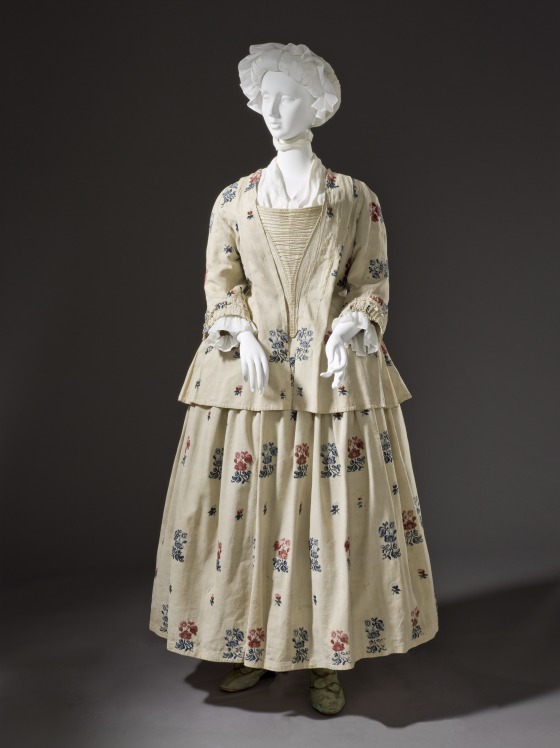
Dated c.1770's, this light and simple looking Caraco and matching Petticoat took us a little by surprise. LACMA has obviously dressed a mannequin for a photo shoot of this neat little ensemble - but look! they've dressed it with a finely laced (or stringed) CF detail pair of Stays. We've seen one exactly like this at the Edinburgh Collections Centre and have a few other versions in our Stays image file.
Caraco+Pett - c.1770 - LACMA - HAndBound
C.1770 - LACMA

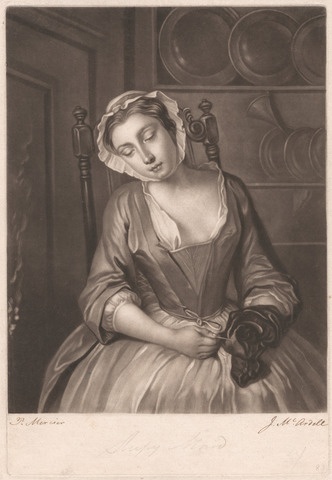
The Sleeping Maid - McArdell - 1756, who wore fully boned stays article, 18th century stay research, HandBound historical Costumes, made to measure stays, bespoke georgian technique made stays, 18thc corsetry, where can I get a pair of stays made?This is obviously not conclusive proof that this type of decorated stays were meant (nor always meant) to be seen but it is another weight on the side of Purposeful Visibility - what a great little phrase.
I'm sure we've used this image before but there is the lovely 'Sleeping Maid' who, though it could be argued, could be wearing her stays visible out of necessity or for practical purposes, is also proudly displaying her pair of Stays.

Anyway, this is not supposed to be a long post - we're in the middle of preparing for The Daily Mail History Festival and we're busy sewing ribbons onto our new McCord Stays especially for the event. Lotsa lv, XXX

Tuesday, 19 May 2015

Techniques of Wearing Working Women's Clothing.

We wanted to gather a collection of images to study how everyday working women's costume was worn. We want to study how Apron's were wrapped, skirts were tucked and caps were mounted. There seems to be a lot of consistencies in some of the working women in painting and we'd like to see if we can plot them and see how consistent they really are.
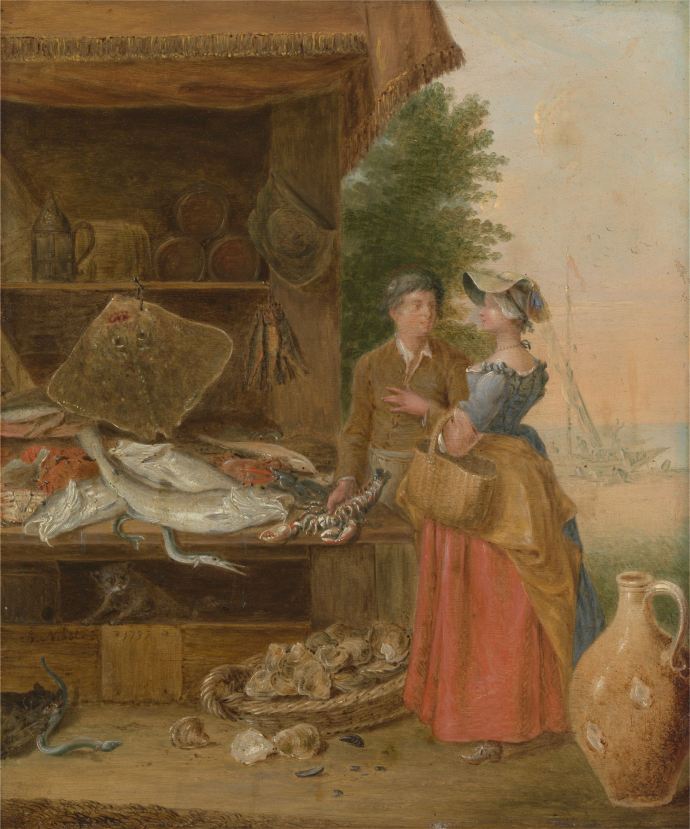
Fishmongers-Nebot -1737 - HandBound
Fishmongers - Nebot - 1737. We seem to like our Fish Stalls! What we did like about this painting is our lady here in the lined Gown. Although there are hints to her being slightly wealthy, she does wear her skirts pinned back and with the contrast lining it means this causes a nice kind of decoration. We'd love to know how they pinned the skirts back - we can use our imagination but it would be nice to know for sure! She also wears a plain red pett and her gown's an Anglais with what looks like puff-pad detail around the sleeves and contrast Cuffs. She wears a pearl/beaded necklace and under cap tied on with ribbon and the obligatory Bergere hat.
- Also just a quick interesting note - this appears to be the first painting we've seen that verifies the fact that the ribbons over the cap were indeed tied at the back of the neck. It seems an interesting point but until this image we could only guess at this - it's nice to have proof!

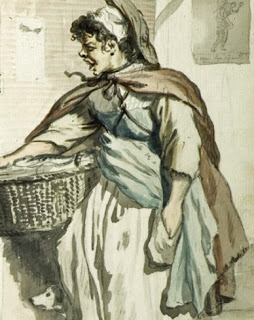
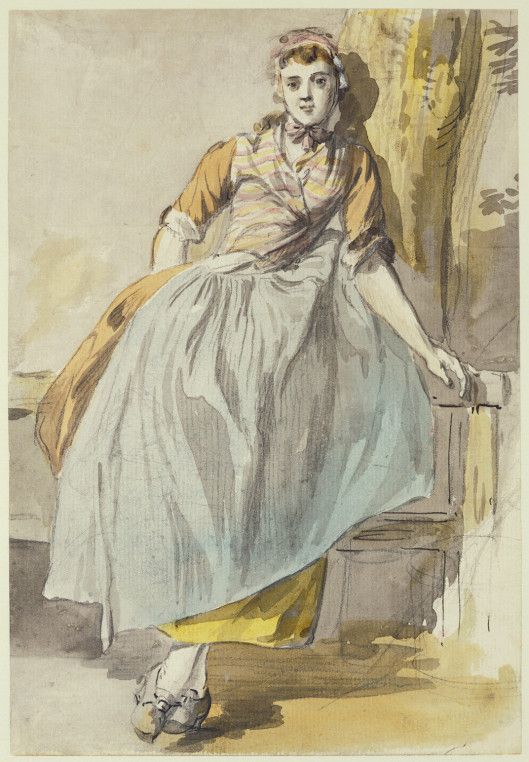
Our Next image is a Paul Sandby Image and one we have well used. Part of his sketches for a possible series on The Cries of London, this watercolour has been dated 1759 and is of a Black Cherry Seller. This laPaul Sandby - c.1759 - Cries of London - Black heart Cherriesdy is a little better dressed than some in the Cries of London and the general details include:
- Brown-ish Robe a l'Anglais with possible cuff detail. Gown pinned back.
- Striped pett.
- Light coloured pocket and blue apron, looks to be just tied around waist.
- Some kind of cap with possible lappets or is an undercap as this could just be a cloth and a ribbon tied round.
- Striped neck cloth.
- Looks to be wearing Stays
- Plain shoes
But Details specific to how she wears her clothing is:
- She is wearing the skirts of her gown pinned back - quite steeply so that much of her petticoat is revealed. Also she has no coloured lining.
- Her apron is blue and long and starts from under her gown by all appearance.
- The pocket is to the side in the place one would assume it to be
- Her neck cloth is not very full, lying quite flatly against her back and not really showing many signs of it being at her front.
Paul Sandby Cries of London - 1759, Sketches of working women, what working women wore, Practical garments, georgian undergarments, Pocket - english c.1745 - V&A based replica costume - HandBound Bespoke Historical Costumes, embroidered Pockets - english- mid 1700's - HandBound Costumes, Undergarments of the 18th century, what georgians wore under their dresses, the history of women's pockets, replica costume and clothing made to measure and based on original garmetns in museums, practical clothing of the 18th century, reproduction costumes for re-enactments and theatre productions, accurate reproduced historical costumes,
Mackeral Seller - P.sandby - 1759
The next image is one we've used over and over again through-out our research. It's not our fault; there's just so many important details contained within it, we have to keep using it as 'an example of...'.
For example, she has been one of the initial images for our plain pocket product and it was her that first made us notice the cross-over straps at her chest. But...lets start afresh here and give her details again:
- Plain light coloured petticoat - could be shift but it's very long and much heavier looking. Did think at one point it could be her Apron but the blue thing is in fact her apron.
- It's a fascinating way of wearing an apron. We've noticed this technique in other paintings - both with Aprons and with their skirts or petticoats. We don't know how they kept them up! We know it appears in this image as if it's her arm but in the next image; Wheatley's Cries of London, you can see that the lady painted there is doing this with her skirts also and it doesn't appear to be just a temporary thing - the lady in Wheatley's painting is concentrating on something else but her skirts are still wrapped round her.
- Back to our Mackeral Seller, her apron being tucked up in this manner reveals her pocket and you get the impression that this could be part of the reason - or atleast a useful side effect.
- Her cloak is worn off her shoulders and tied at her neck. We don' tknow what the cords are from - we are guessing her cloak as in other images it also appears to be the cloak but it could be to hold up the apron. It's certainly not from her basket which some images also show.
- Her shift sleeves are ragged and cuffless, displaying their width of cut.

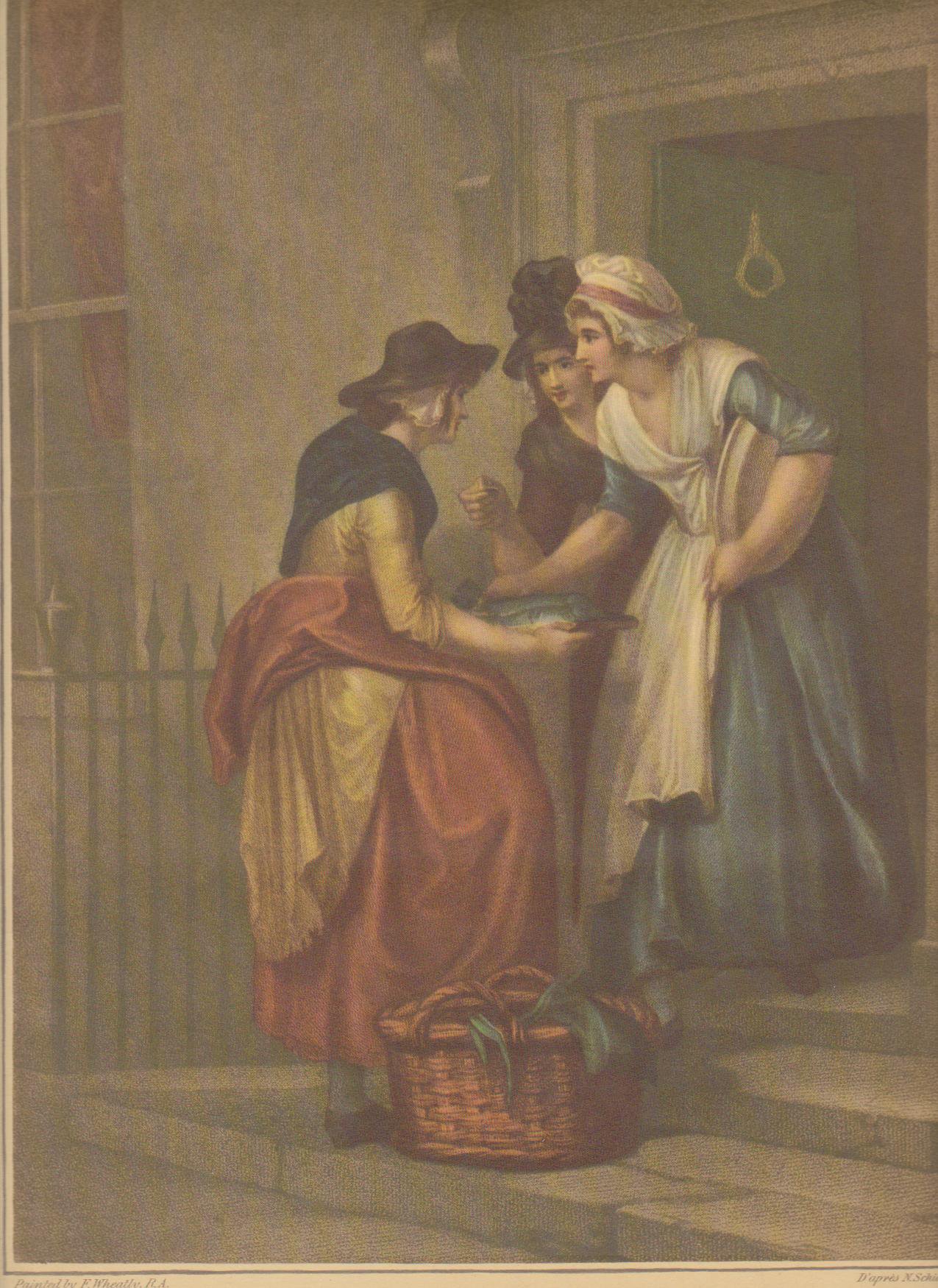
Cries of London - Francis Wheatley - Mackrel Seller  - 1793 -HandBound Research, how working womens clotehs were worn, handbound costume research, handmade historical costume, Custom made period clothing, re-enactment research costuem, Bespoke and tailor amde historical costume, museum replica costumes, reproduction period clothingNext: Painted in 1793 - this series by Francis Wheatley: 'The Cries of London' shows women about 30 years later than those of Paul Sandby's images. Though 30 years have passed these images still contain a lot of similarities, not just in the general items of working women's clothing but in how they were worn also.
In this image you have 3 women. 2 of them we are mainly going to be looking at as the third looks to be a little better dressed and also has less seen of her. So: the Mackerel Seller. - The V&A who houses Paul Sandby's 'Mackerel Seller' detail how her smelliness and the offense she causes by her mere presence is shown by the dog retaliating to her (not shown in the image above) and by the horrified looks of the door she's near. This image however contains nothing of that. She looks well dressed, full of a sense of servant-hood and seems to be useful to the maid(?) who is looking at her products.
- She is wearing a rather short Anglais(?) gown in yellow that only hangs at the back to her lower knee level.
- Her brick-red coloured petticoat is ankle length but must also be the same garment that wraps so fully around her hips. How this is done we have no idea - it's either pulling up her skirts at the front to reveal her knees! or it's an extra, super full skirt (unlikely) or a way of pulling the skirt fullness to one side and wrapping it round - in short we don't know yet. We can't even figure out how it's kept up unless it's pinned (like the first image) or tucked through the pocket openings. How they didn't ease their way back out again is anyone's guess and how it didn't make the skirt tight is also an open question and how it wasn't annoying! is also one we've yet to investigate. However this style crops up time and time again so it must've been useful to the wearer and a way of controlling her flapping skirts while she worked.
- She wears a dark, possibly navy, handkerchief about her shoulders.
- No ruffles or seen shift ends at her sleeves.
- Her hair is worn natural and looks to be in a loose bun kind of way with a undercap being worn with Round Ears or a short lappet - we're not fully au fait with the difference yet! On top of this all is a plain ugly brown straw hat - you can clearly see the difference here between this hat which shouts 'working woman' to the neat Bergere hats with their crisp shallow crown and wide brim.
- She wears grey looking stockings and plain brown shoes.
- Yet her clothes seem in fairly good nick - there could be a little bit of ragging at the back of her gown skirts - it's hard to see but the rest of her is plain, simply dressed, working colours but clean and in good order.
The maid is wearing a plain blue gown - (both working ladies wear gowns cut to the shape of this later period but not in the full fashion of the 90s) - hers seems longer than our Mackerel Seller and is a lovely full looking Blue.
- Her Apron is either one that comes up to her chest and is pinned up with the neckerchief wrapped over the top or it's tied on at the waist with the neckerchief pinned across her chest and tucked into the waist line.
- She holds her apron up with one hand - done very naturally and like she's well used to doing it and carries a tray under her left arm.
- None of the ladies show any glimpse of white under their sleeves from the shift or ruffles so possibly reflecting this form of fashion.
- She wears a cap of the 90's and 80's style and it appears to be made of a soft, fine linen in the way that it hangs and looks a little limp.
- She also has a her hair finely visible - as if it's been scraped back loosely and strands have worked their way.

The next image is by the same artist - Francis Wheatley and is from the same collection of paintings. this lady is entitled 'The Cherry Seller'. We've also used this in our Examples of Working Women in Stays as she seems rather evidently to be in Stays and Petticoats alone. So lets detail what she's wearing:
- She's in a white shift with rather full sleeves looking like they've been rolled up and tucked in (her left arm).
- She has a red-ish petticoat - not tucked up in anyway shape or form.
- She is aso wearing a blue apron, tied at the waist that has the left hand (her left) corner tucked into the tie.
- She has a white handkerchief round her shoulders and a white undercap on under her hat - which looks to be a little more floppy straw hat than a fashionable Milkmaid or Bergere Straw Hat.
- Her Stays are plain brown and don't have any visible straps.

(c) The National Trust for Scotland, Brodick Castle, Garden & Country Park; Supplied by The Public Catalogue Foundation
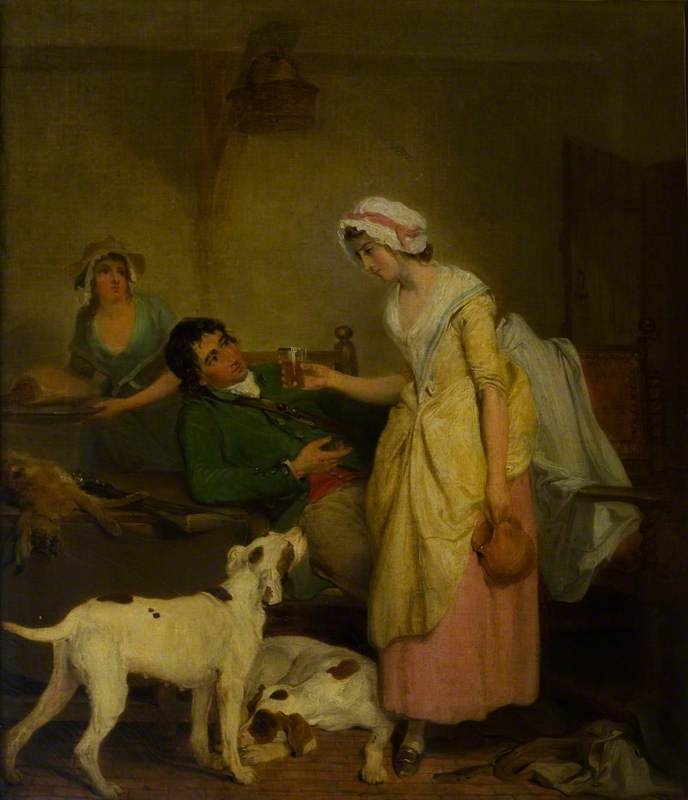
The next image is entitled 'The Sportsman's Refreshment' and was painted around 1775 by Francis Wheatley.
The yellow lady in front:
- Has the skirts of her dress pinned together at the front - this is really useful because it's probably similar to how they pinned it when it was done at the back. You can see the effect this pinning causes - this rucked up skirts around the hip area and making the yellow skirts sit almost at thigh height. This pinning also happens at waist level - covering over the CF point of the gown.
- She wears a pink petticoat - looks fairly heavy so could be quiltedor wool.
- She has plain sleeves, pulled up slightly over her elbow and no frill or glimpse of the shift.
- Her Neck cloth (apparantly ladies in the 18th century just referred to it as a Handkerchief until the 80's went it became the Fichu- Cunnington's) hangs at it's point at the back and is met together with something at the front of her gown just above the neckline. It then either sits slightly crossed over so that it covers the CF opening. It has a striped edge.
- She wears a Mob Cap with pinkish Ribbon and interestingly this sits completely over her hair - the ribbon alone must've held it on or else a hair pin or something.

 The lady in the background looking on and holding a plate of bread wears her neck cloth crossed over her chest and probably pinned into that position.
- She wears a floppy looking country hat with either an Undercap with lappets or a cap with lappets - don't ask us about the differences; we're too are still figuring that out!
- She wears a darkish looking green robe with a darkish looking green neck cloth and a little glimpse of her shift at the neckline.
Cherry seller - Wheatley - 1793
To be Continued....

Friday, 3 April 2015

Did Stays Make You Bulky?

The Bulkiness of Stays:

This is an intriguing topic - it began for us atleast, when we were sampling our very first pair of Stays. We'd already discovered 4 ways in which to make a bad pair of Stays and were just coming to the finalised product that was similar in feel, shape and weight as the original in the museum. (This is our Bath Stays, based on BATMC1.27.865 and currently found in the Online Shop).
We'd read somewhere that Stays were not always worn as tight as they could be and so while we tested out our new Stays we decided to see what it felt like and looked like to not have the Stays laced up fully. The result was Bulk - pure bulk! When they were laced up tightly there was indeed a feeling of slimness but not too the same degree in which the un-stayed body can be, but have them only a little looser and both the photographs and the spacial feel of the body was much bigger.
As we carried on with our research so we began to notice certain drawings in which the lady look slender around her neck and arms but the bulk of her torso seemed out of proportion.
In the back of our minds the thoughts stirred....
Examples:
This is not a declaration of fact - please let us be clear.  Consider it, instead, as us looking into it and laying down what we've found before you and seeing if you come to the same conclusion. You may not - but please join in the discussion and lets see if we can't get this century finally pinned down in our understanding!

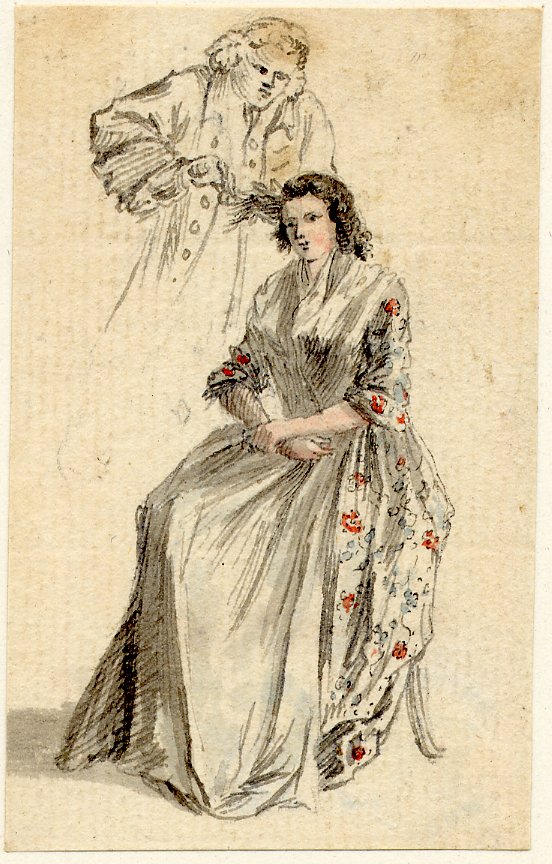
The first images is Paul Sandby's - Hairdresser - dated after 1745.Hairdressing a lady in the mid 18th century by Paul Sandby, example of a lady in stays, HandBound made to measure Historical costume, hand made Historical and period clothing, re-enactment costume, theatre and film costumiers,  custom made corsets, HandBound Corset and costume research
There's so much in this sketch, but, more than anything, what we find precious about Paul Sandby's work is the normal-ness of it - the amazing ability he had to make the subjects of his paintings so every-day. We realise it's labouring a point, but when you look at his sketches they somehow make it feel like the scene before you is ordinary for you too.
Painted as part of a group of sketches he made while in Edinburgh after the rebellion in 1745, these quick snatches of street scenes are fascinating. Here is a hairdresser dressing a lady's hair. She sits patiently in a beautiful floral Robe a l'Anglais with large-ish sleeves and possibly a folded up, loose cuff by the looks of things. We've used her because, contrary to her neck and arm her torso looks quite forbidding. It seems to be much larger than it should be. Just for interest and detail, she also wears a handkerchief about her neck and a long white apron - classic Undress or Day wear.Lady Maynard by Paul Sandby - c.1757, ladies costume from the 18th century, Undress for wealthy women in the mid 1700s, example of a lady in stays, HandBound made to measure Historical costume, hand made Historical and period clothing, re-enactment costume, theatre and film costumiers, custom made corsets, HandBound Corset and costume research,  After Rebellion in Edinburgh series of Sketches by Paul Sandby, Royal Collection of Art, Yale collection, Historical costume research, Goergian dress and fashionable shapes
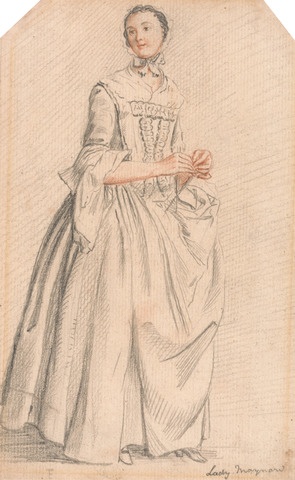
- Lady Maynard 1757.
You are more than welcome to disagree with us entirely here but we find Lady Maynard a little bigger than expected in this next painting. Painted around 1757, this portrait of Lady Maynard could just be slightly sketched wrong, or her arms are hiding the neatness of the waist but when we first saw it we thought it was another possible example of either A) One not wearing her Stays laced in as tight as she might. Or B) Where her Stays make her look slightly bigger than reality.
It's also an image of a Lady wearing her Apron tucked up slightly to one side. We have noticed this in a few of the working women portraits but not in a wealthy woman's one. It's just for noting that's all.
The uselessness of this topic is that really there are no answers! How are we ever going to know if Lady Maynard in her Undress wore her Stays slightly looser? Or if this bulk that we imagine here was just a wrong move of a paint brush? Or even if women thought that Stays did make their shape bigger but as the use of them was so normal and the structure they gave to the body so essential, that it meant that this fact was simply accepted. Perhaps it could even be that this was a part of the development for slimmer stays in the later part of the 18th. The truth is - this is all pure conjecture - fun! But conjecture all the same.
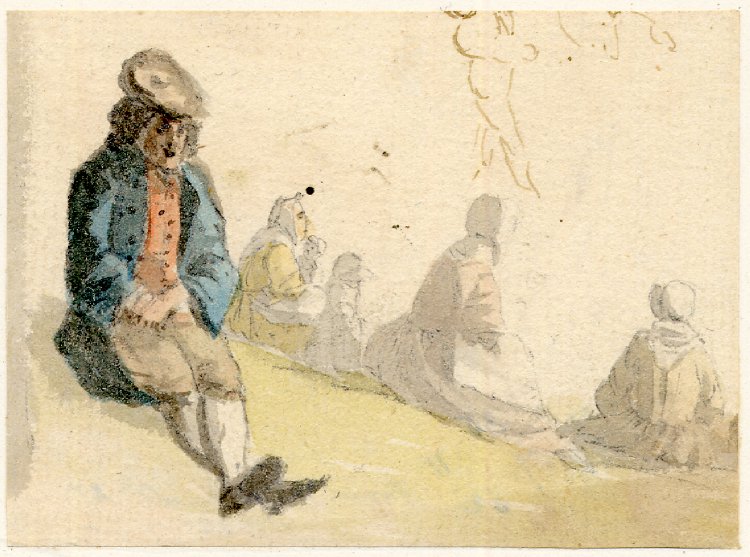
Another image is again from Paul Sandby's Edinburgh sketches and is entitled 'Man on Grass' Evidently it is not the man we are interested but the women, beautifully painted in faded watercolour sitting just beyond him -like  a hazy day in the sunshine!
Edinburgh Sketches by Paul Sandby- c.1745 - HandBound
Looking at the ladies in the background!
We've only really included this image, not because it contains any direct proof, but more because it continues the image of this bulkier lady. No matter what size you are, wrapping yourself with closely sewn whalebone and layers of fabric is always going to add some sort of bulk to the body. We know the Stays can be pulled in to enhance the waist and they certainly control and place very firmly the bust in one place and one place alone but the overall effect is of a much more imposing shape than the natural body. This cannot be helped - it is the very definition of a pair of Stays.
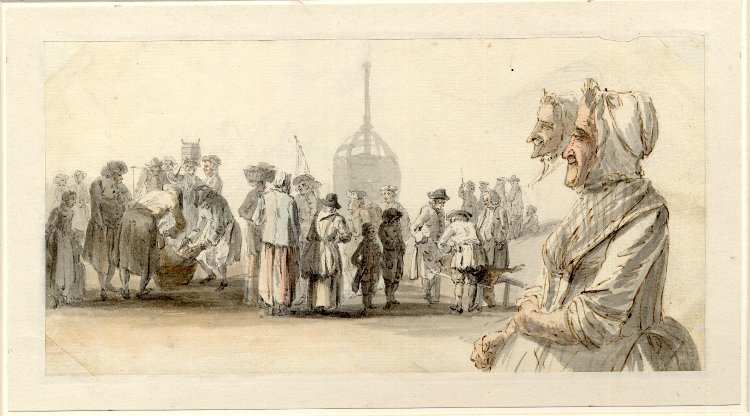
The next image is even better for seeing the way the Stays hold the body - the lady is definitely not slim nor slender but in this image you can see very clearly what a pair of stays can do to a larger figure - especially if not worn tight. The pure fact is that you are pulling into a rigid shaped corset all the stomach and bust. Where as some clothes can disguise a larger shape, a corset can't - it solidifies it and contains it and holds it rigid and therefore the finished impression can be almost war-like.
Meat Mkt after 1745 - P.Sandby - HandBound
Meat market by Paul Sandby - after 1745
Copley - American artist of 18th century fashion, HandBound Costumes research into 18th c. fashion, Hand Made period and historical costume, Made to measure period clothing, Historical costumes speciallising in 18th century underwear, custom made corsetry and 18th century Stays, Theatre and Film costumiers,
1764 - sitter unknown
Isn't she splendid! Please just appreciate Paul Sandby's talent for capturing life and it's reality. You can see from the above image how broad she is around the waist.
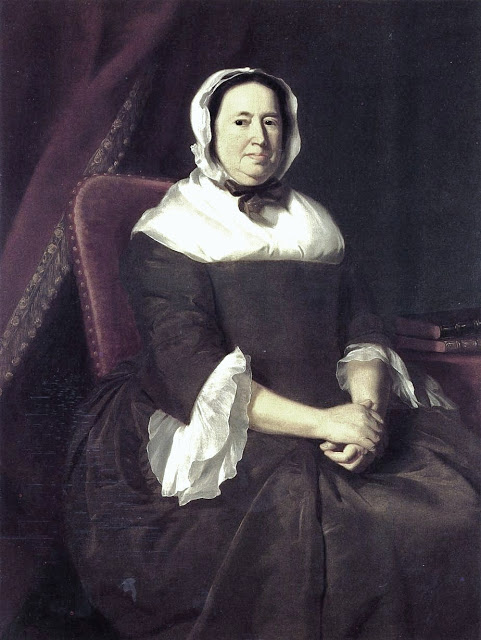
- J.S.Copley - Sitter Unknown - 1764.
The following image shows the same effect, though American and therefore an image we tend to leave in the American section of our research, but it shows this solidity so very well. This is actually a very interesting dress. It appears to not be CF opening gown but has an open skirt front to the skirts of the gown - possibly a wrapped over front that secured down one side? - Similar to Tudor costume? Or a CB Closing gown?
The next image is a detail from C.Phillips painting 'The Tea Party at Lord Harrington's' and dated 1730. Both ladies look to our eye a little but larger than life in the torC.Phillips-Tea_Party-1730-HandBoundso department but in the case of the lady in the background this may just be the busyness of her robe. However, the lady in salmon-ish pink in the fore ground is a little more distinctive. Again, it could just be the artist's skill, but it does look like she's larger than her proportions suggest.
She also looks to be wearing a Lappet cap with the lappets folded up, which is nice to see!
It's much easier to excuse slim looking drawings as flights of fancy - that ideal delicate, small waisted girl - like our modern day fashion drawings, quickly sketched with super long legs and barely any waist to speak of. Infact we can sometimes find it hard not to draw slim women - adding a larger waist somehow takes more imagination! But these larger drawings would've certainly been unwanted had it not been a kind of realistic look, wouldn't they? And the Artist would've wanted to atleast not insult his subjects, even if he wasn't going for flattery? We've put question marks on these almost cried out pleas as we are well aware that our modern-day outlook could be clouding our view.

Saturday, 21 February 2015

Another Glimpse into the World of The Stomacher-Style Stays

The Stomacher Style Stays Debate:


The Stomacher-Style Stays Debate:

We think it's become clear that this topic needs more in-depth research.
So, please consider this little post as the new beginnings of our research!
Stays - 1700-60 - NT - HandBound
There seems to be two views on whether the decorated-front Stays that we find in our museums were actually worn to be seen. For example, the lady that helped us at our Study Session at the Edinburgh Collections Centre said that in her opinion they were not worn to be seen - like our modern day decorated Bra's with their lace covered colours and central bows - they were just private prettiness for the individual.
Trying to dress the mannequin with the Stays to be seen, certainly throws up MANY problems. It seems nigh-on impossible, infact,  if certain techniques weren't used - and there doesn't appear to be any evidence they were.  Some of the techniques that we had to adopt in order for our dress to work were 1) CF slits on the skirts for the front points to overlap over. And 2) A hook sewn on the Stays at the waist point on which would tie the various undergarments. (please see our 'Stomacher Style Stays Problem' post) This could lead us to the conclusion that perhaps they weren't worn to be seen.
However, we've just been re-reading the 'Handbook of English Costume in the 18th Century' by C.W Cunnington and P.Cunnington and we came across this little statement.

" The Corset:
This laced behind and with a plain or embroidered front acted as a stomacher.
'The Stays were white silk covered with a lacing through which a handkerchief was passed,' 1739 Mrs Delaney's Autobiography."

We wonder if they tried dressing a mannequin as they described the Stays being worn here though....

I know that many Historians now find faults with some of the Cunningtons findings in this more modern-day light, but it is their gathering of costumes and research that bulks out the collection  stored in the  Gallery of English Costume in Manchester. They weren't just stating their facts from some holed-up office having never seen a garment, but were avidly collecting and researching and making sense of what they found as they could understand it.
When we made our Philadelphia Stays, we also sampled along side it a Robe a
Robe a l'Anglais dresses, HandBound Bepsoke historical costume, made-to-measure Eighteenth Century Clothing, re-enactment gowns, everyday 1700's costume, how to wear georgian clothing, duchess of devonshire costume, dress like antionettel'Anglais with Robings designed to come to the edge of the stays. In doing this we un-earthed a whole MASSIVE amount of problems. We emailed some of the museums to find out how they dealt with the problems (see our Post ' The Stomacher Stays Problem'). It was the Manchester Galleries that contacted us back and said that they didn't know how they were worn and had the same problems when dressing one of the stays in their collection.

The quote that the Cunnington's use to support their statement that they were used as 'Stomachers' is an important one. Mrs Delaney here writes that the white silk stays were covered with a lacing through which a neck cloth (in those days referred to as a Handkerchief) was tucked. This act of tucking the handkerchief through the lacing is physically impossible if the Stays weren't displaying this CF lacing to the outside world.
Buckles for her Stays:
This tiny insert into their book about Stays acting as Stomachers has also re-opened for us what we were always confused about. There was an item of jewellery called ' a buckle for the Stays'. (Never 'Stays Buckle' but 'Buckle for the Stays', which seems a mouthful but there you are!) It seems to have been a buckle that went over the front of the stays, between the robings of the dress, and was used to tuck the handkerchief in to if there was no CF lacing. At first we just asked 'How did it clip on' but then we began to wonder how it was even seen and used if the Stays were never seen. We can show you no photos for this as we have never seen one!

So, consider this the start of more research...