Tuesday, 6 November 2012

Petticoat and Panniers again...

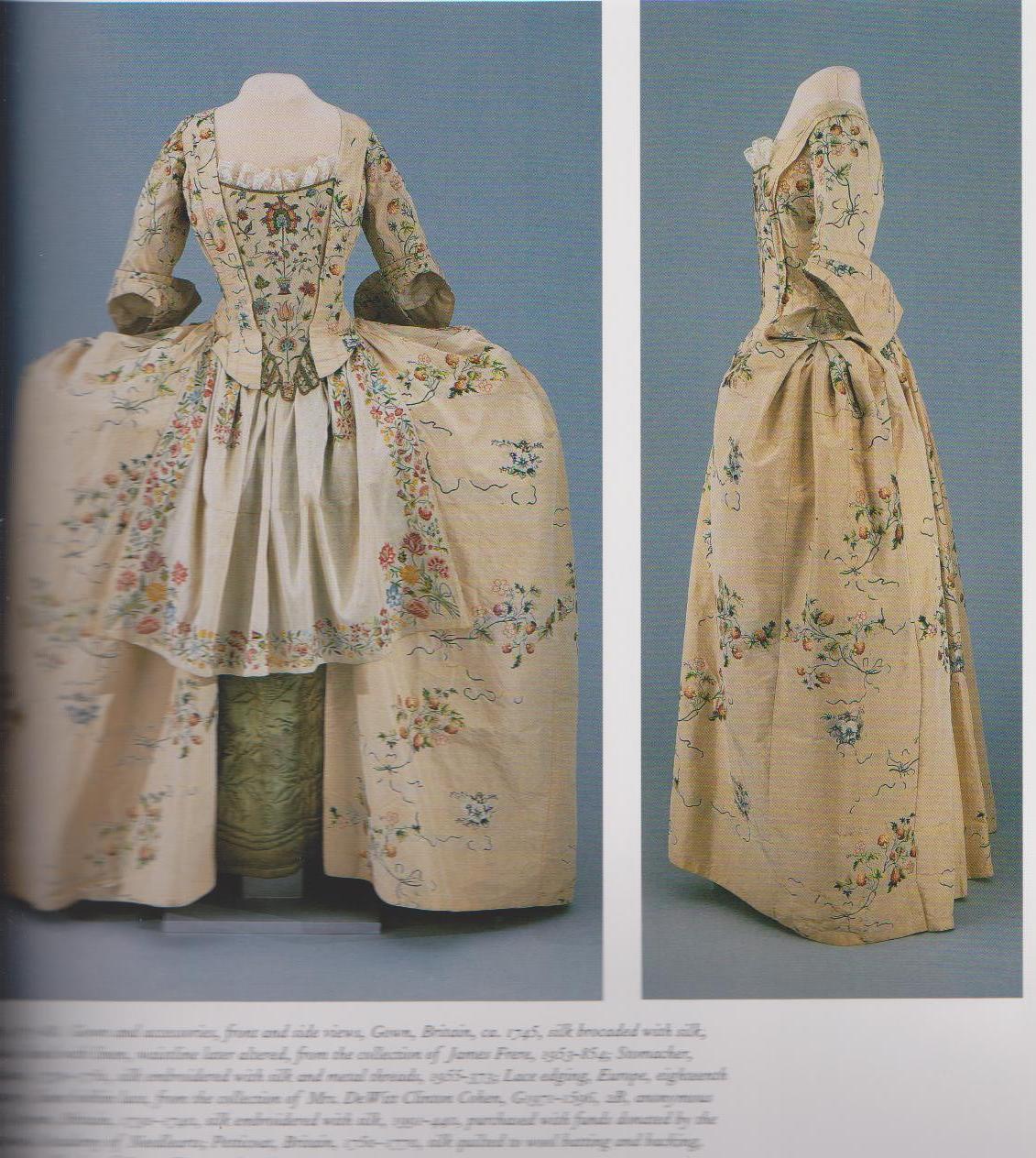
I bought the book 'What Clothes Reveal' and on page 57, lo and behold, we have a pannier dress dating from the c.1745 from the James Frere collection at Colonial Williamsburg with a quilted petticoat over a pair of panniers. Again, according to the book the two aren't from a matching outfit though both belong to the James Frere's collection but here's another example of a) How it looks, as the petticoat is a normal quilted petticoat shape and yet it manages over the vast panniers and b) How another Historian has felt able to pair them together. 
That's two places now at either ends of the globe.


Friday, 2 November 2012

The Loose Cuff Detail:

I have just come back from an impromptu visit to London where I managed to grab about an hour in the National Portrait Gallery. I had to pretty much run round it and what I did manage to see I managed to make some extremely quick notes on. 

Now, at the moment, my research is limited to the mid eighteenth century and there were a couple of portraits from that period that got me seriously thinking about sleeves...

The Tyers Family by Francis Hayman 1740

George Whitefield by John Wollaston 1738

Now the Hayman Painting (top) is too small for you to see the detail - at the end of this blog I'll try and do an extra large size so you can see the cuff details - but for now;  the Mother of the group (in yellow) and the pink daughter to the right definitely seem to be wearing loose sleeves that are gathered up into a cuff but not, infact, a separate cuff that's been sewn on as a separate detail. The George Whitefield painting (which I love! I'm a christian so it's like 'wahoo-move that Spirit!) has a lady in the centre front who seems to de displaying the same loose but gathered up cuff.
This got me thinking.
Did the Cuff detail, that is well known and well worn in this period, begin life as a fold over pleat from the looser dresses and looser sleeves of the 20's and 30's?
In both paintings they are evidently pinched into a detail at the front to encourage the cuff shape but it does seem to be part of the sleeve and not a sewn on addition.

Now we know that the trend for looser dresses drifted in from the late 1600's. You can see this from the many examples of portraiture from that time. Have a look at some of the paintings I've posted up below. (see De Troy's La Declaration, the Watteau painting, the 'Charlotte Elisabeth in Beieren' painting and the two Pesne paintings below. They should give you a pretty good idea of the kind of image we're talking about here
Iris Brooke describes the 1720's and upto the 1740's as:
'The Sacks were not at their best for they still hung loosely from the shoulders and were not yet moulded onto a fitted lining at the back.'
You can definitely see this in the Watteau portrait.

If we move on a few years, to1747-48, you can see in Gainsborough's 'Mr and Mrs Carter' (see right), as upright and splendid as she is, her sleeves are still looser than those in later dresses. You might not be able to really see it from this size picture and I can't make it zoom in as it doesn't have the pixel depth but they are much broader round the top arm than you'd expect
The sack-back is also much looser and comes further across the shoulders than the classic mid to late1700's sack-back look.
But mainly in this image, you also have the obvious detail of the cuff, slinging itself away from the sleeve in a sharp angle. This suggests that this cuff here is in fact a false one, or one sewn on as a distinct 'separate cuff'. Compare this to the two paintings above and you can see the difference. To me Mrs Carter is a sort of growth blend example of the looser dresses of the early 1700's meeting with the more fitted neater dresses of the late 1700's. 

Here's another 1730's image of baggy dresses. The 'La Declaration' by De Troy in 1731.


(Charlotte Elisabeth in Beieren - I currently don't know which artist painted it - c.1713)

(Watteau - cousins - 1717-1718)

(Pesne - 1716)    
                                                       
(Pesne - Queen of Prussia - 1737)

In the image above, dating from 1737, her heavy velvet dress displays the creases from the looser sleeves, but this is of a later period and again, if you compare it to the other paintings above you can see how her dress is already more streamline than those previous. Her dress, I'll admit partly because of the heaviness of the fabric, is frumpy at the front where-as later on in the century you begin to see these pleats move more to the side. It's also worth noting that less and less would such dresses be made out of such a heavy fabric. 
There's another image from the 1730's that echoes her style.


See how full it is at the front and how much it echoes more of the Farthingale style dresses of the Elizabethan Court. Compare this to a mid-century dress and the contrast is stark. 

Both these dresses are from the 1760's, and although the first image is titchy it does show the neatness and fitted look that we associate with the 1700's. Also note the sleeves, see how tight they are compared to the baggier version from earlier on in the century


I guess all of this is just interesting details that makes you excited when you stumble across them. I had my own pre-conceived ideas about what the dresses from this period were like and the more I research into them the more they surprise me: like little treasures.

.

Can I also, just comment on the blue girl in the centre of the painting. She's wearing an apron and it's obviously just been pinned on. In the book the 'Tudor Tailor' the couple who write it point this out also and it's an interesting and complicating fact to those trying to make replica's. I just simply don't want to pin my customers in!


Wednesday, 17 October 2012

Just been doing some more research and I've found this image from the Kyoto Museum...

This is dated c.1760's and it's a funny shaped corset for that period. I'd expect that kind of shape to be more late 70's and 80's but what interests me is the quilted petticoat.
They're not draped over huge panniers but it does appear to be the later styled 'french' side boxes that could be hinged up to help the lady through doorways or into carriages. 
I'm only having a good old guess but it's a valuable image.


Thursday, 11 October 2012

Quilted Petticoats Over Panniers?

I can't figure this out....
My assumption, based on a quote from Iris Brooke's book 'Dress and Undress' was that the quilted petticoat replaced hoops.

' Mrs Rook...is just come from France and is come without a hoop, and tells me that except in their high dress nobody wears one. Their sacs are made proportionally narrow and short, opened before with a petticoat and trimmed and with a stiff quilted petticoat under.' (p.83)
Meaning you either wore a quilted petticoat or you wore a hoop.

But my little world seems to be tumbling down and within the same book it seems.

One of my favourite drawings from her book is on p.82:


And until now I hadn't actually noticed that she seems to be wearing a quilted petticoat under her apparent apron. I don't know if you can see it from this scanned in image but there's definite etches of the repeated circular design associated with quilted petticoats. You can see it just as she lifts up her apron. 
But Iris doesn't often mention where she's sourced her information from and I don't just want to decide from a mere drawing that therefore they were worn over panniers.
So I did some hunting online but didn't come up with much.

Except I did find this image in the Manchester Art Gallery:


And I rang them and tried to find out about the outfit but the gentleman on the phone couldn't give me much info. He did say that the petticoat wasn't initially part of the outer dress ensemble and that they at the museum had put the two of them together and he did say that, as far as he was aware it was a normal quilted petticoat, one not cut differently or made with longer sides to accomodate the panniers. I asked him what made them put the two together but he didn't know the answer to that and said he couldn't give me anymore infomation as the outfit was on display and therefore not at liberty to be looked at.
'Pity' I said.

And that is that; at this precise moment.
If anyone out there has any other images or infomation, oh I'd be oh-so-grateful if you got in touch.

Saturday, 29 September 2012

hand made stays, fully boned.

After some frustrating feelings that I wasn't quite hitting the spot with my research, I decided that what I REALLY wanted to do was to try and replicate a pair of stays properly, hand stitching and everything.

Now, on my numerous trips to the wonderful Bath Fashion Museum Study Facilities, they had unearthed two pairs of stays for me to study. I'd measured them, done rough drawings and marvelled at the stiffness, the thickness and the weight of them and then had moved on. (They had pulled out a whole selection from the 1700's and I wanted to goggle at as much as I could!) So I decided to go back and have another look at them and see what others they might have.

(Image Courtesy of the Fashion Museum, Bath and North East Somerset Council)

Look at them all! 
The really curly beige one at the top left and the darker brown pair with light ribbon were the original two that I had studied previously.

Here's my quick study the first time round of the Beige pair. BATMC 1.25,85

But this time round I had the whole 2 hours to just concentrate on them. I've included in this blog my sketches from the 'red silk pair' which had no number attached to it and a photo off them.

(Image courtesy of the Fashion Museum,  Bath and North East Somerset Council)

 But the real delight was BATMC 1.27.865. Which, in the first photo is the pair on the bottom right-hand side. They tick ALL the boxes: the lining is coming off in places so that one is able to view the techniques from inside, some of the ribbons had begun to be worn away so you are able to view the stitching techniques used to sew the pieces together and they are from the middle of the century. IT's hard to contain a 'WAHOO!' even after all these months (I did this trip back in july).
I am so excited about this. For the passed few months I've slowly been pattern cutting, doing samples and now, finally, starting on my first go at them.

(Image courtesy of the Fashion Museum, Bath and North East Somerset Council)

These are just my sketches from that study. I've enclosed more photo's of the actual corset on the page designated it.

(Image courtesy of the Fashion Museum, Bath and North East Somerset Council)

(Image courtesy of the Fashion Museum, Bath and North East Somerset Council)

I haven't YET been able to find the exact right shade of linen, I'm working on a slightly lighter shade at the moment but it will do for now. And obviously it's a no-no to baleen (whalebone) so I'm using cane as none of my other researching has found a strong enough substitute on such a narrow size. You can get mock whalebone but the narrowest I've found at the moment is only 5mm and that's still starting to feel pretty flimsy, cane on the other hand, when made up, has felt more solid and similar to the stays in the museums than anything else.
Following are just photo's of my beginnings. Consider though, that each long stitching line took me about 30 minutes, by the time you cut the cane, place it in and sew the line up. It's very time consuming.

Also, before I embark on just uploading all my images here's a photo of a corset in the V&A, and just how similar it is, although not fully boned and from a later period, it just shows you how consistent the general look of this period remained. 
I was reminded of this one when I first saw the pair of stays I am now replicating.

My Work:


Well this me so far, but I'm hoping to be updating this as each section gets sewn and prepared...phew, that seems a long way away though.


Thursday, 16 August 2012

Blue Dupion Corset.


My second sample and still not 100% happy with the boning. This was pattern cut for my brother's fiance and I'm really pleased with the subtle blue of the fabric. But, have decided that these are more 'fun' style corsets: I wanna go after the bigger fish....


Thursday, 28 June 2012


I am sitting here, with the washing machine going hectic as it's reaching the final stages of it's cycle (an extra hot one to wash the linens properly), there are canvasses dripping and drying by the fire as they're being prepared for steaming, and me, trying to get my blog going on my laptop. It's like a weird melting pot of time periods. But I do feel like I'm slowly getting somewhere with all my research and sampling. I have two corsets half started/half finished on my work table upstairs and one that's already been posted up on Etsy. I have various types of boning coming out of my ears and, never mind all the various types of fabric and canvasses I've stacked around the place in my quest to try and get the weight right for a well made corset. OOOh but I do love all this. I was at the shop today, my other job, just tingling to get home and start working again.